
70% of People Browse E-commerce With No Intention to Buy Anything
A learn article on how generative AI is reshaping e-commerce: most visitors browse without purchase intent, product pages shift to AI video and conversational search, and AEO plus AI-driven content production change campaign workflows.
Let me start with a question.
The last time you opened a shopping app, were you planning to buy something specific — or just browsing?
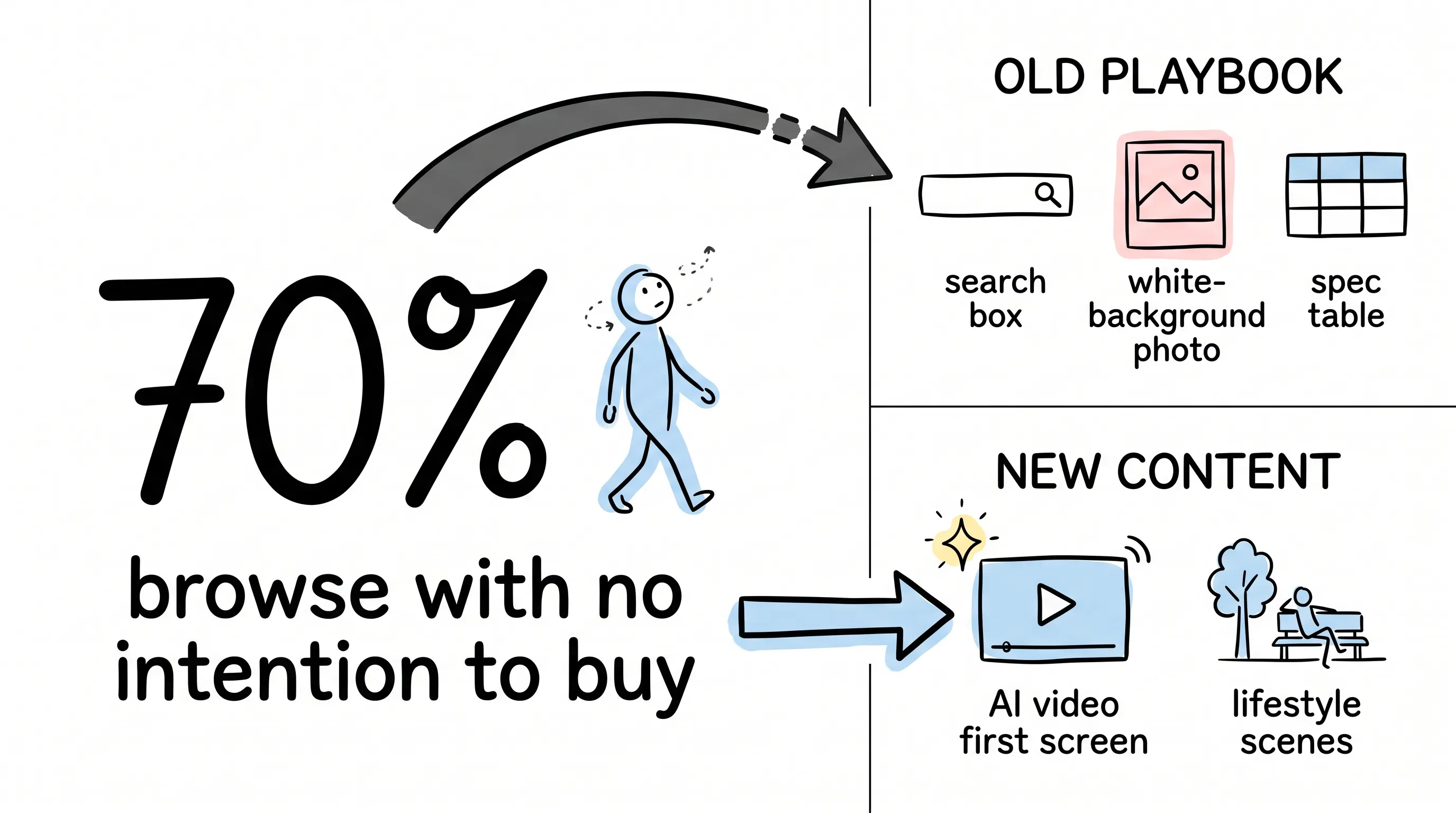
I recently came across an observation from Zalando, one of Europe's largest fashion e-commerce platforms. They found that 70% of users on their platform, especially the younger ones, open the app with no clear shopping intent at all.
70%. Seventy percent.
They didn't come to place an order. They came to wander. To look for inspiration, for a feeling, for that sense of connection — "this piece of clothing somehow gets me."
Think about it, and it gets scary. Because the entire traditional e-commerce playbook was built around people who arrive with clear intent: the search box, the white-background photo, the spec table, the price sort.
But today, most people stroll in.
And for a stroller, a white-background product photo will never make them stay.
A Static Image Can No Longer Feed the Browsers
A Zalando executive in charge of content solutions gave two wonderfully plain examples in her talk: a pair of tennis shoes, photographed on a tennis court; a pair of hiking boots, photographed out in the hills.
Sounds obvious, right? But users simply understand it better, and they're more willing to stop and look.
Then came a bold move. Starting October 2025, the first screen of every product detail page is no longer an image — it's video. AI-enhanced video and lifestyle scene shots, to be exact.
The result? Engagement rates more than 10% higher. Users return more often and stay longer.
But the part I found truly interesting came later: in some categories, they actually sold less.
Selling less is not a bad thing. Because when users buy the right thing, returns go down too.
The purpose of content was never to make people buy more. It's to make people buy right.
The Giants Are Training Your Customers for You
In recent years, something truly mass-market happened: ChatGPT went mainstream. From kids to grandparents, everyone now feels comfortable chatting with AI.
The chain reaction from this is longer than most people think.
It hit customer service first. If my mom is used to talking to ChatGPT, she has zero psychological barrier talking to a shopping site's support bot.
Then it hit search. I used to type "red shoes" into a search box. Now I say: "I'm going hiking this weekend, looking for a pair of red hiking boots."
More natural expression, more context — and you get to the answer faster.
Amazon went further. They put a generative chatbot called Rufus directly inside the product detail page. Buying a remote-control car for your kid? You no longer unfold that long, collapsible spec sheet to hunt for "batteries included or not." You just ask.
This is where the giants are formidable. Amazon is both a retail giant and a technology company. Every time it optimizes the experience by one step, it re-trains consumer expectations a little more.
Once you've used the good version, there is no going back. Today, a product page without AI Q&A genuinely bothers me.
For every other retailer, that is both a blessing and a curse.
The Search Front Door Is Being Rewritten
One founder in retail-tech shared her research: roughly 50% of searches on Google today are performed by agents and chatbots.
Fifty percent.
And Google itself is changing. A search used to return twenty-plus pages of results; nobody has ever honestly scrolled past page three. Now the results are compressed to around 10 pages. If your product doesn't make it in, it effectively doesn't exist.
So where everyone used to talk SEO, now you have to talk AEO — AI Engine Optimization. (AEO: making your product information legible to AI engines, so they understand it and choose to cite it.)
Her advice was extremely practical: don't rush to optimize — measure your baseline first. What do you actually look like inside the major AI engines today? How are you being mentioned? Use tools like Profound and Scrunch AI to find out.
If you don't know your current score, how can you talk about raising it?
From 6–8 Weeks to 2–3 Days
Fashion's trend cycle has become almost absurd. A trend surfaces on TikTok in the morning; by the weekend it may already be dead.
Can the traditional process keep up? It cannot.
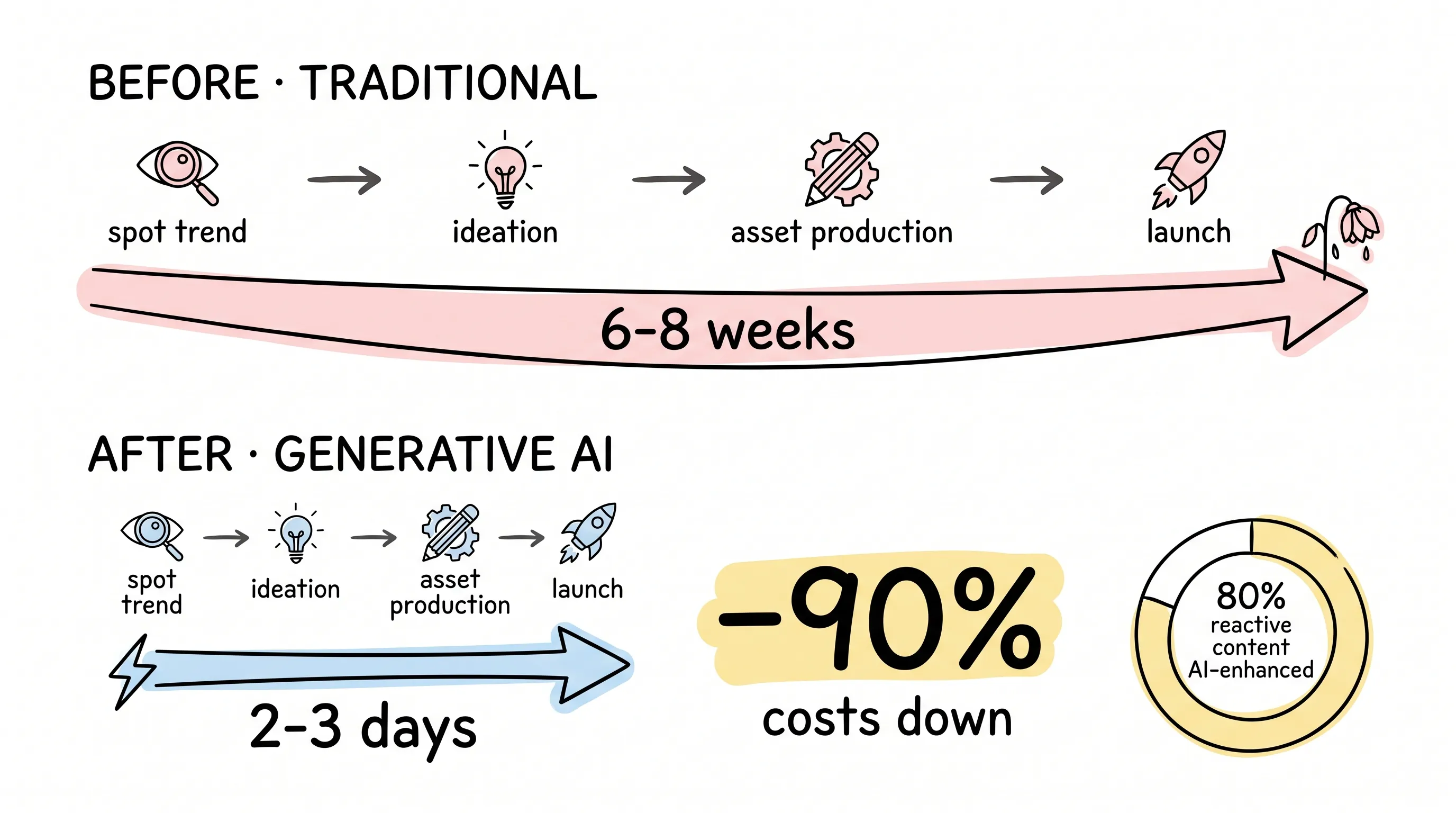
Zalando says that even they count as fast: producing a full marketing campaign takes them 6 to 8 weeks. But a trend lives for days. Chasing a 6-to-8-week cycle means chasing a corpse.
After adopting generative AI: from spotting a trend, to ideation, to asset production, to launch — compressed to 2 to 3 days. Costs down more than 90%.
Speed up, costs down, and suddenly you dare to act. Today, about 80% of their reactive content is AI-enhanced, and it's built around each market's local cultural moments. The old global one-size-fits-all content logic has become localized playbooks, each playing its own game.
They also launched a new format called Stories: the first purely visual-first experience on their platform — expert-curated, short videos, refreshed weekly, with guest creators coming in to talk styling and garment care. In their words, it's the first time technology, creativity, and storytelling have truly converged on their platform.
What Is Choice Paralysis?
Dig one level deeper and you hit another number.
McKinsey's annual fashion industry report did the math: 74% of consumers have abandoned a purchase simply because there were too many choices and they didn't know how to pick.
74%. Three-quarters of people are not being scared off by price. They're drowning in choice.
Why don't social platforms have this problem? On TikTok and Instagram, you are a person the algorithm knows. Every post you watch feeds the algorithm; it understands you better, and it feels better to you.
On e-commerce sites, by contrast, 98% of visitors are anonymous.
98%. You don't know who they are, where they just came from, or what they want. Beyond a few pitiful clues in UTM parameters and clickstreams, personalization barely has a toehold.
One e-commerce consultancy CEO offered what I consider a farther-off judgment: agentic commerce.
So what is agentic commerce?
It means that as a consumer, you will train an AI agent of your own. Hand it your email; let it read all your order confirmations. Let it know your wardrobe, your preferences, your typical spend.
Then this agent goes online for you, carrying your full profile, and negotiates with brands: "Here is my owner's spending power and purchase intent. Give me a discount nobody else gets — or I walk."
The agent is measured on closing deals for its owner, so it has every incentive to fight for the best terms.
At that point, personalization changes shape: no longer a website guessing what you like, but your agent and the brand's system — two AIs, negotiating.
Personalization Has Three Layers. Don't Burn Money on the Fancy One First
That retail-tech founder broke today's highest-impact personalization into three layers. The order matters.
Layer one: product recommendations.
In a physical store, what's the most valuable sentence a good salesperson can say? "This top goes beautifully with those pants." Online, translating that sentence is what personalized recommendation does. Their data shows that this layer alone delivers a 288% lift in purchases.
288%. This may well be the layer with the best return on investment.
Layer two: natural-language search.
Let people find things in plain speech: "Attending a formal wedding in the evening, want something long, in this color family." The AI has to understand occasion, length, and color — not throw back a pile of irrelevant results.
Layer three: virtual try-on.
Honesty first: virtual try-on still cannot solve sizing today. It cannot tell you "this shoe, take a 42 or a 42.5." But for users who just want to see "how would this look together," it's already good enough.
I especially love something she said: we are not creating new behavior. We are using technology to move a great experience that has existed offline for decades onto the internet — and run it more efficiently.
The Fitting Room Is E-commerce's Last Hard Bone
On virtual try-on, Zalando has pushed three things.
First: 3D virtual try-on, starting with shoes. Shoes are the most technically mature category. By the end of 2025, users can already view 10,000 SKUs of footwear in 3D and virtually try them on; per the plan at that time, the entire footwear catalog moves into the immersive experience by 2026.
Second: the virtual fitting room, starting with jeans. Jeans are among the hardest garments to fit — many cuts, up to twenty-plus sizes. Their approach: build a 3D digital twin of the user's body, put the jeans "on" the twin, and show exactly where it's tight and where it's loose — before ordering.
Third: a feature called Style It. One tap on a product page, and up pops an avatar that puts together whole outfits for you in every variation. It starts with designer brands, because those customers are the most willing to pay for a full look. In the future, you'll be able to sculpt your own avatar and share your outfits with friends.
But there's a dead knot here, and they admit it themselves: data.
If you want users to see products in 3D with precise fit, brands have to hand over their 3D assets and sizing data. Whoever wants to give customers more information must first give information.
Yet once this asset exists, its uses compound exponentially: your own site can use it, any marketplace you list on can use it, a physical store can hang a virtual mirror on the wall — where a digital try-on is faster than a real one, and you order on the spot, or save it and keep browsing at home.
Gold Is Hiding in the Returns
One founder began her career in the size-technology industry. She offered a number: 87% of returns happen because of size and fit.
87%. That's not a technology problem. It's an information-asymmetry problem between buyer and seller.
She then spent years on the front line of store sales — by her own count, ten thousand-plus hours soaked in fitting rooms. And she shared what I found the most practical scenario in the entire piece:
Tag the merchandise, track a garment's movement through the store, log when it's taken into the fitting room. Combine that with membership data: what size this customer usually buys, how often she visits. Now you can tell your staff at the morning meeting: for this pair of jeans, customers who take size 34 almost always come back to exchange for a 32 — don't hand them the 34; tell them up front this style runs large.
One sentence. One good experience. One more loyal customer. Customers who are served this way find it harder and harder to leave.
Her summary: the technology isn't mysterious, and it doesn't have to be expensive. It's connecting the data scattered across departments and systems, and giving it first to the people closest to the customer.
Two Times It Blew Up
Of course, the other side has to be told. In recent years, digital models and digital garments have had two serious flame-outs.
The first was Levi's. They wanted to use digital models to "improve diversity," and users tore into them: the real world is full of diverse people — why would you manufacture digital ones? It ended in apology and takedown.
The second was the fashion magazine Vogue, which published images of digital humans wearing digital garments. Readers announced outright they would cancel their subscriptions.
Where did it go wrong?
It went wrong by asking the wrong question, giving no options, and not telling the truth.
That founder broke it down finely: users are segmented. Some want to see bodies and styles like their own; some only care about function and new arrivals. What a brand should do is research by segment, then offer a choice — do you want to see digital models, or real humans? — and say plainly: this is a digital model, a digital rendering of a certain look.
Fashion is a business that cares about "real." Even traditional models aren't "real," even catalog shoots are posed and pulled and prodded — but what users want, always, is a visible sense of authenticity.
Move the conversation from "how was this made" to "what value does it bring the user" — more accurate information, fewer returns, more inspiration — and the resistance shrinks on its own.
Creatives' Anxiety — Photography Has Been Through This Already
Many people worry AI will destroy the creative professions: photographers, stylists, models.
One former Chief Digital Officer at a European sneaker retailer told a particularly vivid story. A few years ago, when generative tools had just emerged, a photographer called him mid-shoot: he was shooting a sneaker campaign and was short three ceramic prop columns. The shoot was dead in the water.
The CDO asked: what do you have on hand?
The photographer said: an apple crate.
He said: then shoot the shoes on the apple crate, and let AI fill in the background.
The photographer froze. And after the fill-in was done, he suddenly discovered he'd been unlocked — for his next shoot he set the scene in the desert, and later, on the Moon.
He later said this was the same shock photography went through when it moved from film to digital. The film holdouts are still around, and doing fine; but everyone who wanted higher output without losing creative quality went digital. AI, for today's creative industry, is that same digital moment.
The wild ideas you never dared to think — now achievable without burning a fortune on production. And going forward, as product discovery shifts from search engines to AI assistants and social media, content only gets scarcer and more valuable.
Using tools to amplify your brand's own voice will be the defining homework of the next few years.
Small Companies: Don't Start by Picking Tools
Finally, an answer to a question on many minds: if you're a small company with no money and no team, how do you use generative AI without producing work that's forgettably average?
The three speakers' views converged, surprisingly.
Tools are billed on usage. Low traffic, low usage, low cost — small companies can actually afford them. Big companies face security reviews, procurement processes, layer upon layer of testing. Small companies don't. Small boats turn fast.
But the most crucial point: don't start from tools. Start from workflow.
First map your business process: where are you short-handed? Where are you inefficient? Where would a helper directly turn into more revenue? Maybe you need a new image every week and nobody to retouch it. Maybe customer-service replies are slow. Maybe the long copy never gets written.
Every gap maps to a category of tool. Choose backwards: start from goals and bottlenecks, and find the tool that fills the gap — instead of trying every hot tool on the market first.
And one more thing, for companies of every size: every investment must have calculable returns. Only when you can compute the payback do you dare keep experimenting and iterating.
A Closing Word
The whitepaper Zalando co-published cites a McKinsey estimate from 2025: generative AI could add up to $275 billion in operating profit to the fashion and luxury industries.
$275 billion. The window of opportunity: three to five years.
But what I keep coming back to is that number from the opening: 70% of people stroll in with no intention to buy.
The decisive battleground of e-commerce is shifting from "shelve everything everywhere" to "make the wanderer understand, believe, and feel moved."
Images will look more and more real. Pages will get better and better at conversation. Returns will keep falling. And the customers who have truly been understood will come back, again and again.
Turn the wanderers into the ones who come back.
That is the new exam generative AI has just handed to e-commerce.
May you answer it beautifully.
Continue reading
Related articles

Cross-Border Business: Time to Upgrade Your AI Toolbox
A learn article explaining how AI tools help cross-border e-commerce sellers clear five hurdles: language, regulation, logistics, payments, and fraud. It outlines a five-compartment toolbox, a five-step adoption path, and metrics such as conversion rate and CLV, while cautioning against over-reliance on AI.

AI Is Taking Over the Dirty Work of Social Media Marketing, One Task at a Time
This learn article outlines four social media marketing tasks AI can handle — audience analytics, content drafting and design, ad targeting and creative testing, and spam moderation — and cautions that taste, judgment, and data security remain human responsibilities.

AI Is Already This Good — Why Is Your Social Media Marketing Still Pure Manpower?
An overview of 18 AI tools for social media marketing, organized into six categories covering audience research, content creation, scheduling, comment and DM handling, ad management, and visual production, plus notes on personalization, prediction, and emerging trends.