
62% of Companies Are Paying for Their Dirty Data
An opinion piece on CRM data quality in the age of agentic AI, citing Validity and Adobe survey findings that poor data quality has caused revenue losses and stalled AI projects, and arguing for data governance and human review before delegating marketing execution to AI agents.
62%.
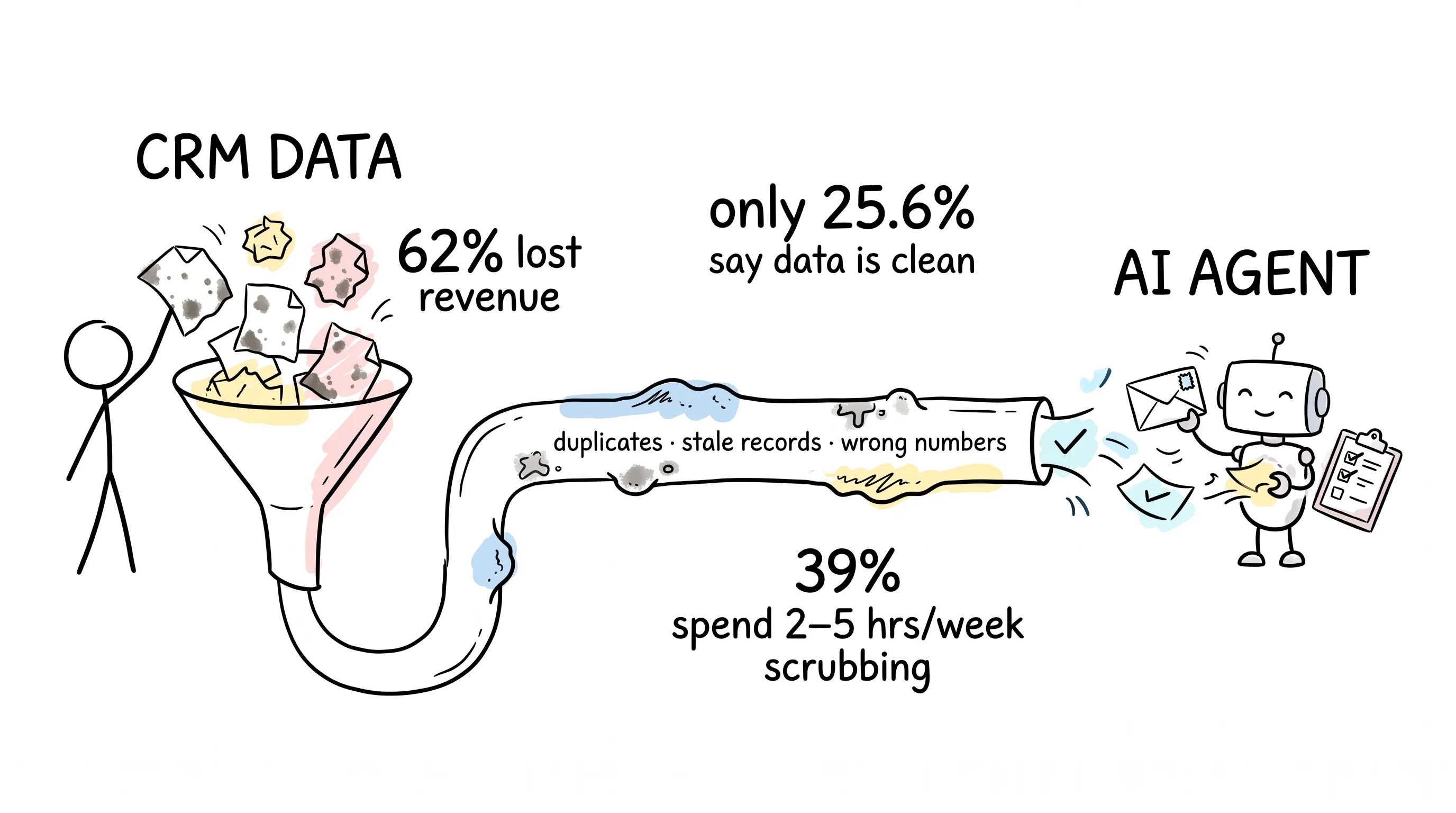
I came across that number recently, and I sat with it for a long time. Validity, a customer data platform vendor, surveyed 500 marketers around the world, and one of the findings was this: 62% of companies have lost revenue outright because their CRM (customer relationship management) data quality is too poor.
Not "money left on the table." Lost, outright.
What is CRM data? It's the customer information stored in your system: contact details, interaction records, what people bought, what they complained about, which emails got opened. Marketing automation, sales forecasting, customer operations — it all runs on this feed.
By rights, this is the lifeblood of marketing. You'd think companies would keep it spotless.
Quite the opposite.
In the same survey, people were asked: how much of your CRM data is complete and accurate? Only 25.6% dared to say that more than 75% of their data is clean. Nearly half admitted their company gets battered by data quality issues day in and day out: 39% of people spend 2–5 hours a week scrubbing data, and 24% spend 6–10 hours.
Do the math. At 3 hours a week over 50 weeks, that's 150 hours — roughly 19 working days. A whole month in which one person does no real work, just fixing phone numbers in the system, merging duplicate customers, and deleting stale records.
Why does scrubbing data take so much time?
Because nobody owns it, and nobody cooperates. CRM data gets poured in from several departments: marketing enters the contacts, sales logs the follow-ups, customer service logs the tickets. Everyone assumes it's the other side's mess to clean up, and no one has the authority to make the final call. So the dirty data just sits there, piling up.
The data is dirty, fine — you use it yourself, and you suffer the dirt yourself. The problem is that all of this is about to be fed to AI.
AI's Ceiling Is Data's Floor
These past two years, the hottest word in marketing has been agentic AI. What does it mean? It means you no longer just have AI write copy for you — you let it work on its own: send the emails itself, score the leads itself, adjust the budgets itself.
Its execution is frighteningly good. But it has one defining trait: it never doubts.
You tell it that customer Zhang San recently looked at a competitor, and it believes Zhang San looked at a competitor. You tell it that Li Si renewed last month, and it sends Li Si a renewal thank-you note — even though Li Si churned three months ago. It's a super intern with flawless execution and zero judgment. Whatever you feed it, that's what it does.
So in the age of agents, data quality has gone from "a nuisance" to "a matter of survival."
This isn't just my gut talking. Adobe's 2026 AI and Digital Trends report called out this "readiness gap" directly: 52% of companies admit that poorly integrated data is already dragging down their AI projects; 75% say data integration and quality is the biggest hurdle to putting agents into production.
What's interesting, though, is another set of numbers in the same report. Asked where their AI investment should focus, only 32% of companies listed "data quality, unification, and governance" as a priority. Only 20% are willing to spend money on "increasing data value."
What is the readiness gap, exactly?
52% of companies know the bottleneck is in the data; only 32% treat it as a priority. Everyone knows where the problem is — they just don't fix it there.
Dirty Data Doesn't Explode, It Bleeds
Some people say: so the data's a bit dirty — how bad can it be?
I asked myself the same question. Then I saw another set of numbers in the Validity survey, and I stopped asking.
Among executives (both C-level and VP-level), 44% admit: the company has lost real money because of data quality issues. And the losses weren't dramatic at all: a forecast published with the wrong numbers, renewals that slipped through the cracks, deals in hand that slipped away, marketing budgets spent on people who should never have been bothered.
Courtney Grab, Senior Director of Customer and Lifecycle Marketing at Validity, put it perfectly. The gist: dirty data rarely detonates one big bomb — it's a hundred small cuts. A forecast off by a few points, a customer who should have converted but doesn't, one record too stale and a renewal quietly slides away. By the time executives notice, the losses are already baked into the numbers headed for the board.
Painfully true.
68% of respondents said the performance numbers they reported have been questioned — even retracted — because the underlying data was wrong.
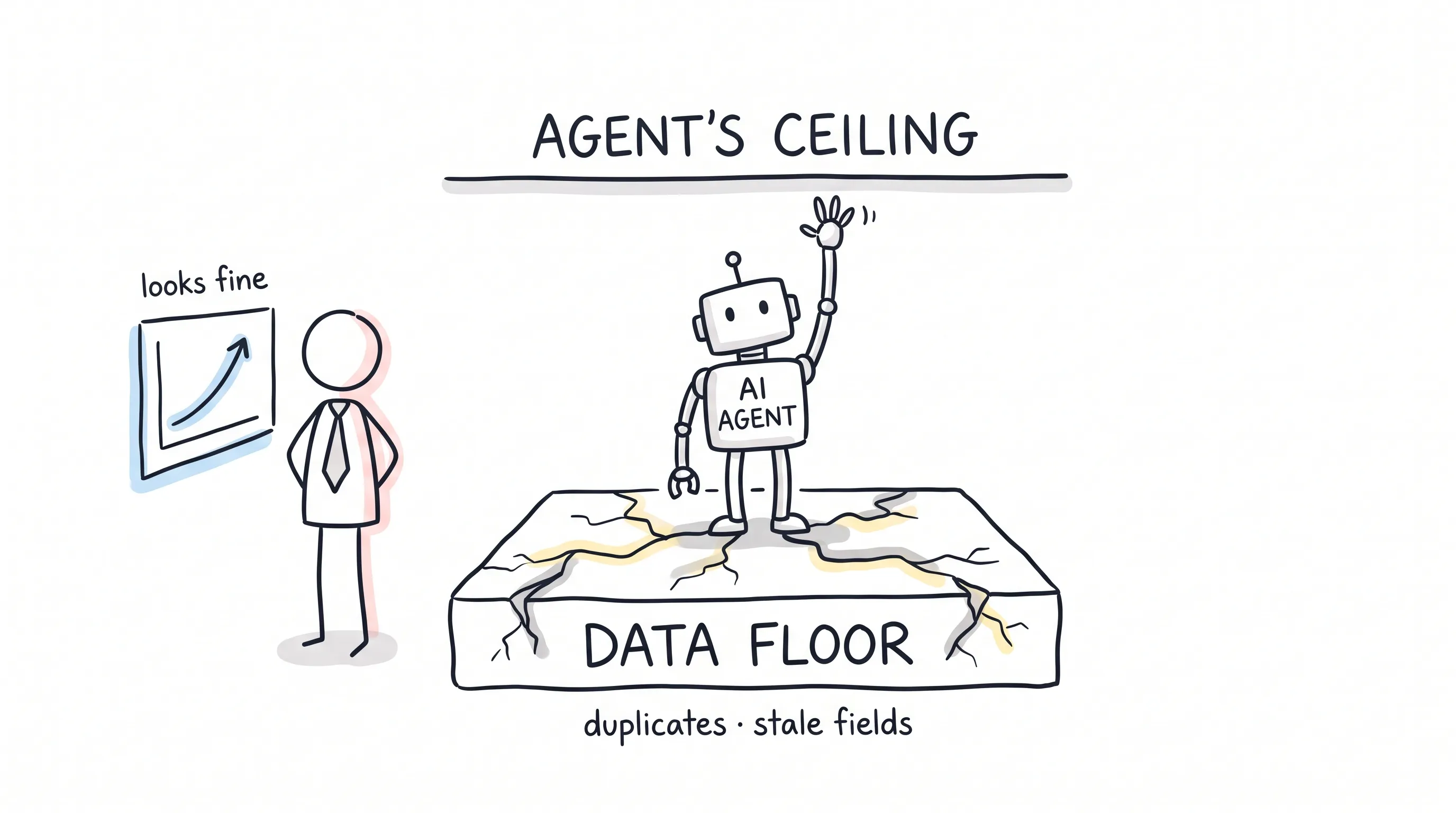
Picture the scene. At the quarterly meeting, you're pointing at a beautiful growth curve, in full stride. Then the CFO quietly asks: this number — is it right?
And there's an even more insidious way this kind of error kills: not on the internal books, but in the customer's mind. Subscription preferences go stale, personalization pushes the wrong content, the message meant for segment A goes to B. Each one is a small breach of trust. Customers want to be seen, not guessed at. A thousand small betrayals add up to more than an incident — they become your reputation.
So what's a marketer to do? Salesforce's State of Marketing survey offered an answer that's equal parts sad and funny: route around the problem. 84% of respondents chose to send one-size-fits-all, no-segmentation blasts. The data can't be trusted anyway, so forget segmentation — blast everyone.
Data was supposed to help us understand customers better. Somewhere along the way, it made us afraid to.
44.7%: Handing Over the Wheel Entirely
Everything above still assumed "dirty data, used by humans."
The thing that truly sent a chill down my spine is this number: 44.7% of marketers let AI run end to end with no human review at all. Which emails go out, how leads get scored, where budgets shift — fully delegated.
Keep in mind: every single one of AI's actions rests on data that even its own people wouldn't vouch for.
One misdirected email is an embarrassment. One miscalculated lead score is a lost customer. One misallocated budget is real money. And compliance is messier still: consent records have expired, unsubscribe requests sit unprocessed, the same person exists as three separate profiles — and AI emails every one of them. There used to be human checkpoints; these problems got caught at the last gate. Now the gate is gone.
Dirty data plus full automation: errors replicate at machine speed.
Knowing the Data Isn't Ready, Why Still Charge Ahead?
Logically, the story should end here: the data isn't ready, so fix the data first, then do AI. Everyone understands the reasoning.
But in reality, nearly every company is charging ahead. Why?
Because the board is pushing hard.
Laura Christensen, Senior Director of Professional Services and Customer Success at Validity, explains the logic of this especially well. When executives sign off on an AI project, she says, they assume the data underneath is solid. In reality, duplicate profiles, outdated fields, and unmarked holes are the norm. It's not that leadership is irresponsible — it's that they're too far from the data.
Executives' confidence comes from the dashboard. But the data lives in the database.
That line deserves to be copied down by anyone who leads.
What does the board see? Beautiful dashboards, one after another. Conversion rates, ROI, growth curves, red and green. They can't see the database beneath the dashboard: the duplicate customer profiles, the outdated contact information, the dirty fields nobody claims. The dashboard is the nicely renovated storefront; the database is the foundation. If the foundation has hollow spots, you can't see them from the storefront.
So as long as the dashboards still look good, the board thinks: great, accelerate. Meanwhile the people on the front line know perfectly well: this data simply can't support agents. In the survey, only 56.7% of marketers felt they were "mostly" ready to put their data to work for AI.
Knowing what "data readiness" means and actually being ready are two different things. The first is copying answers in an open-book exam; the second is working every problem yourself.
In a Salesforce report on enterprise agents, Shibani Ahuja, SVP of Data and AI Strategy, said something I couldn't agree with more. The gist: every meeting room is asking whether we're not moving fast enough. But the data's answer is that the advantage never belongs to those who set out first — it belongs to those who set out seriously: feed the data properly first, think first about where a human must stay in the loop, and build the guardrails before you need them.
Set out first, or set out seriously. That's the choice every company launching an AI project faces in 2026.
My Take
Which brings me to my advice.
If the board pushes hard, don't dig in and refuse, and don't blindly charge either. Do one thing: educate the board.
How? Keep laying out the truth behind the dashboards. Pour a little cold water on the enthusiasm, yes — but also explain the real opportunities thoroughly. Data governance is a company-wide affair; and the people closest to the data usually aren't the CIO, but the front-line colleagues who edit records in the system all day — listen to them. Even before the project is approved, run prototypes and deep tests to find where the data will break down.
One more thing that's often overlooked: what gets fed to agents isn't just CRM data — it's also organizational knowledge like product docs and help center content. If that content is wrong, the AI assistant will cheerfully recite wrong product information to customers.
I know this is hard. Everyone is racing. The technical reality is that things change too fast — a prototype that couldn't run nine months ago might run today, so nobody dares slow down. But agents are only accountable to the people who feed them. The governance time you save today will come back tomorrow as complaints, bad debt, and retracted forecasts — with interest.
An agent's ceiling is your data's floor.
Lay the foundation first, then build. That's not slow — that's the fastest road there is.
Here's wishing you never have to answer that "is this number right?" at the quarterly meeting.
Continue reading
Related articles

Cross-Border Business: Time to Upgrade Your AI Toolbox
A learn article explaining how AI tools help cross-border e-commerce sellers clear five hurdles: language, regulation, logistics, payments, and fraud. It outlines a five-compartment toolbox, a five-step adoption path, and metrics such as conversion rate and CLV, while cautioning against over-reliance on AI.

AI Is Taking Over the Dirty Work of Social Media Marketing, One Task at a Time
This learn article outlines four social media marketing tasks AI can handle — audience analytics, content drafting and design, ad targeting and creative testing, and spam moderation — and cautions that taste, judgment, and data security remain human responsibilities.

AI Is Already This Good — Why Is Your Social Media Marketing Still Pure Manpower?
An overview of 18 AI tools for social media marketing, organized into six categories covering audience research, content creation, scheduling, comment and DM handling, ad management, and visual production, plus notes on personalization, prediction, and emerging trends.