
2026, and AI Is Reshuffling the Entire Business of Marketing
A learn article discussing five Gartner predictions for 2026 on how AI reshapes marketing, covering agentic AI, verified content over viral reach, composable teams, ambient intelligence, and low adoption of GenAI shopping tools.
A few days ago, I had dinner with an old friend who has been in marketing for over a decade.
He looked worn out: traffic keeps getting pricier, the team keeps running on fumes, and the boss keeps asking, day after day — what can AI actually do for marketing?
I didn't answer directly. Instead, I told him about a set of predictions Gartner released at the end of last year. Five of them. Every single one tied to AI.
He went quiet for a moment, then said: so this isn't a question of whether to use AI. The whole of marketing has to grow back, from the roots.
On the way home, I turned those five predictions over in my head, and the more I chewed on them, the more interesting they got. Now, most of 2026 is behind us — and looking back, they read even better.
So today, let me tell you what they say.
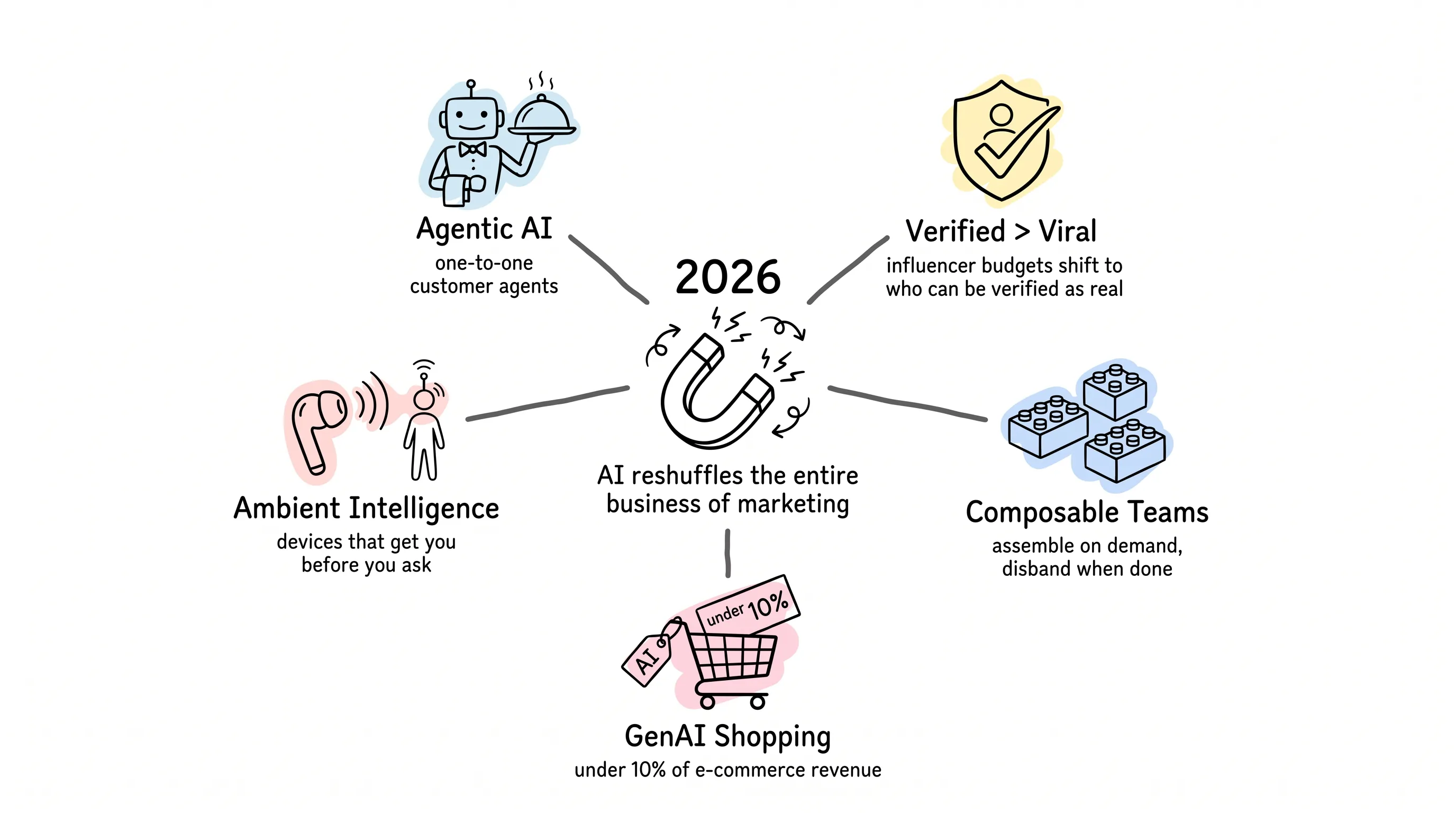
1. Marketing's Job Shifts from "Placing Ads" to "Leading a Team"
What is agentic AI?
Forget the jargon for a second. Put simply, it's AI that can do the work on its own — and make its own calls. You don't feed it instructions one by one; it gets the job done by itself.
Gartner's view: in 2026, a large number of brands will put this kind of AI to work in one-to-one conversations with customers.
What does that mean?
In the past, every promo reminder, every restock nudge, every personalized recommendation was designed piece by piece by marketers and pushed out batch by batch. Now, all of that can be handed to agents: each agent watches its own customer — reminding when it's time to remind, restocking when it's time to restock, recommending when it's time to recommend.
What's it like? Like having a personal butler standing next to every single customer.
Just picture that for a second.
Of course, the precondition is getting data, content, and context governance built first. If the foundation is shaky, the agents have nothing to work with.
But look the cost in the eye, too: the entire traditional marketing-tech stack gets flattened. We used to build channels and run campaigns, one campaign at a time. Going forward, the marketer's core job becomes watching these agents — and making sure they don't drift off course.
Execution goes to the machine. Judgment stays with the human.
That sentence is worth copying down and taping above every marketer's desk.
2. Influencer Money Is Getting Harder to Earn
Second prediction: influencer marketing.
AI-generated content is everywhere. How much is "everywhere"? Content grown on social platforms has already flooded search results.
But have you stopped to ask one question: is any of it real?
Is it a real creator's honest experience, or an AI-generated clone mass-produced by the dozen? Consumers can't tell. Neither can brands.
And it gets worse — deepfakes. Faces can be fabricated. Voices can be fabricated. Even a "personal endorsement" can be fabricated.
So Gartner's call is that brand influencer budgets will shift at scale: away from "who has the most followers," toward "who can be verified as real."
I couldn't agree more.
Think about it: trust is the entire foundation of influencer marketing. Trust used to rest on seeing is believing. Now, what you see might be fake. So what's left? Verification. Verify who the creator is. Verify where the content came from.
Going forward, one creator who can prove they're real is worth more than a hundred viral hits of unknown origin.
3. Marketing Organizations: Break the Pyramid, Build with Lego
Third prediction, and it's about organizations. Of the five, I think this one bites the hardest.
AI has taken over execution, so the "pairs of hands" on the team are shrinking. What happens to the organization?
Gartner's answer: flatten it, fragment it, turn it into Lego bricks.
What's a composable organization?
It means teams are no longer cut into neat squares by channel or function. They assemble on demand. This quarter, there's a battle to fight — pull people from across the company, snap a small squad together, disband when it's done. Individual contributors get far more autonomy, and hybrid human-plus-AI roles multiply.
So which skills become most valuable?
Digital fluency. Strategic thinking. And the ability to solve problems across departments.
Put simply: machines do the work; humans decide what work is worth doing. Your value isn't in knowing how to use the tools — it's in knowing where to point them.
4. Reaching Customers: from "Ask and Answer" to "It Gets You"
The fourth prediction hinges on one phrase: ambient intelligence.
What does that mean?
Right now, when you look something up on your phone, it's on you. Open the search box, type, ask. You have to speak first.
Next, a whole crowd of AI-powered devices will pop up all around you: watches, glasses, earbuds, speakers, in-car systems. They don't wait for you to speak. They read the moment — context, time, location, habits — and push information to you before you ask.
You walk into a mall, and your earbuds murmur: those shoes you've been eyeing? In stock at this store. On sale, too.
Moments like that are ambient brand touchpoints. Gartner believes they'll become a major channel for brand experience.
Sounds wonderful, right?
But.
For a device to "get you," it has to keep watching you. Data privacy. Constant tracking. User consent. Every one of them is a minefield.
Convenience and privacy are two sides of the same coin. In 2026, that coin gets flipped more and more often.
5. The Most Counterintuitive One: AI Shopping Assistants Aren't That Magical
The first four predictions all said how powerful AI is. The fifth pours cold water on it.
Gartner predicts: consumer-facing GenAI shopping tools will account for less than 10% of e-commerce revenue.
What does that mean?
After all the money the industry poured into AI shopping tools, out of every ten orders, not even one comes from the tool.
Why?
Because consumers don't trust it. They worry the recommendations are skewed. They suspect ads hiding behind the curtain. They're afraid of letting AI make rash calls on their behalf. Even the most eager early adopters — the AI power users — hesitate to let a digital assistant press the checkout button for them.
So the part AI shopping tools genuinely do well, for now, is the front half of the journey: helping you browse, compare, and research. As for the moment money changes hands, people still want to do that themselves.
AI can walk the mall with you — it just can't swipe your card. Yet.
Finally, My Two Cents
Five predictions down. Did you notice? They all point at the same thing.
The division of labor in marketing is being re-cut. Machines take over execution and reach; humans fall back to where judgment, trust, and rule design live.
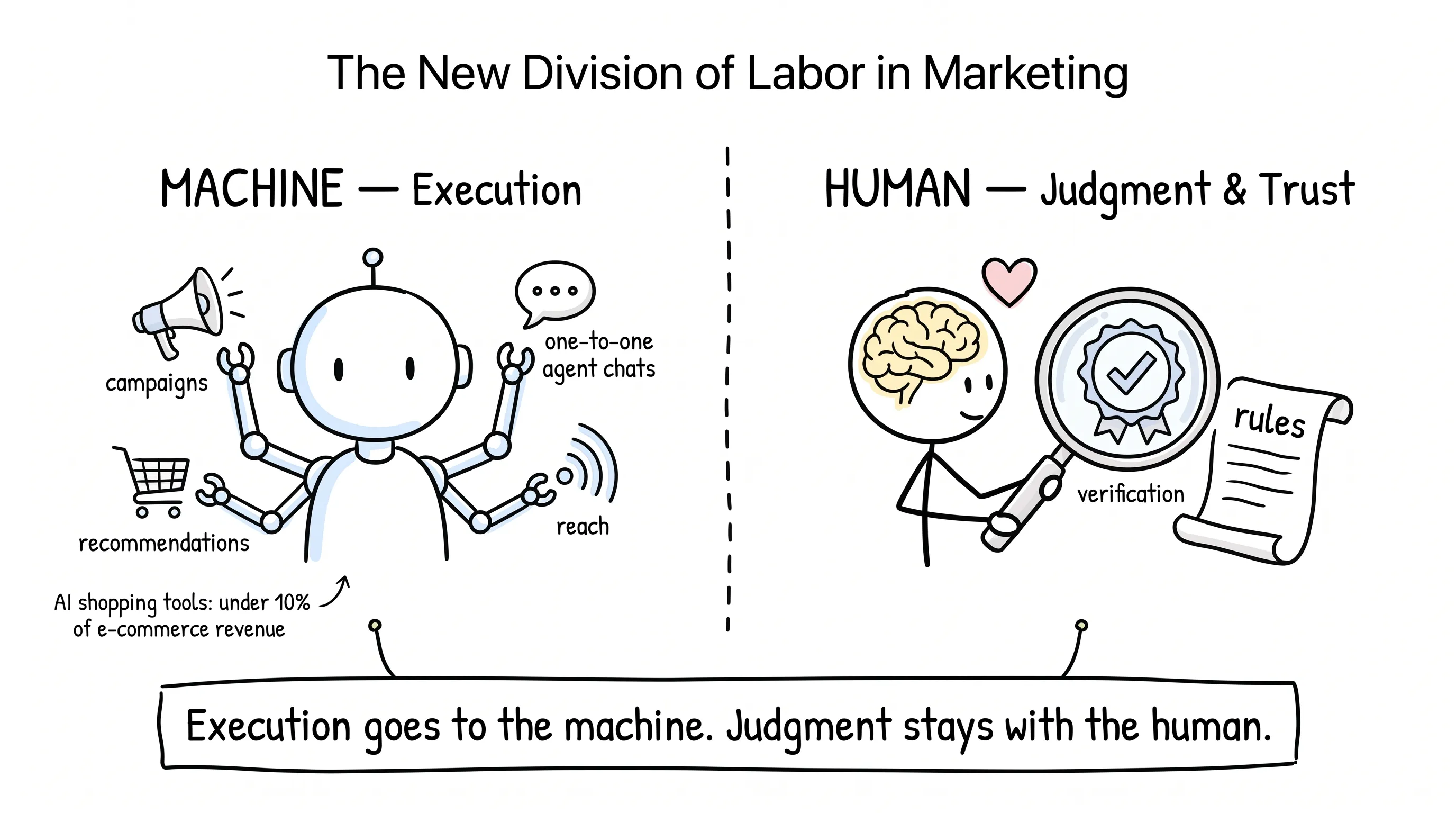
So if you're a marketer, the real question to ask yourself in 2026 is: on the execution side, how much of me is still irreplaceable? On the judgment side, have I banked enough?
Back to that friend at dinner. At the end of the meal, I left him with one line — and I'll leave it with you:
What AI takes away is the "hands" work of marketing. What it leaves us is the "brain" and "heart" work. The faster the hands get, the more the brain and the heart are worth.
Here's to training up your brain and your heart — sooner rather than later.
Continue reading
Related articles

Cross-Border Business: Time to Upgrade Your AI Toolbox
A learn article explaining how AI tools help cross-border e-commerce sellers clear five hurdles: language, regulation, logistics, payments, and fraud. It outlines a five-compartment toolbox, a five-step adoption path, and metrics such as conversion rate and CLV, while cautioning against over-reliance on AI.

AI Is Taking Over the Dirty Work of Social Media Marketing, One Task at a Time
This learn article outlines four social media marketing tasks AI can handle — audience analytics, content drafting and design, ad targeting and creative testing, and spam moderation — and cautions that taste, judgment, and data security remain human responsibilities.

AI Is Already This Good — Why Is Your Social Media Marketing Still Pure Manpower?
An overview of 18 AI tools for social media marketing, organized into six categories covering audience research, content creation, scheduling, comment and DM handling, ad management, and visual production, plus notes on personalization, prediction, and emerging trends.