
134 CEOs Turned In Their Homework: The AI Money Was Spent, but Nobody Did the Math
A learn article recaps a CEO benchmark survey of 134 mid-sized companies, noting most have not formally measured AI returns and that data readiness and system integration are now the top blockers. It contrasts lightweight tool use with process-level automation and advises starting with small, trackable units.
A while back, a friend of mine who runs a manufacturing company took me out to dinner. Halfway through the meal, he pulled out his phone to show me: his company had just rolled out AI tools for every employee — one account each — and over a year, it wasn't cheap.
So he asked me: do you think this money was well spent?
I shot the question back: worth it or not — have you done the math?
He froze. After thinking for a long while, he managed: "Actually... no, I haven't."
That didn't surprise me at all. Because the annual AI benchmark survey just released by Your AI Department turned exactly this question into a precise number.
Your AI Department is a company that specializes in helping mid-sized businesses put AI to work, and it has run its CEO benchmark survey two years in a row. The latest round was fielded at the start of this year, with 134 CEOs responding, most of them leading companies with revenue between $5 million and $500 million. One number in the report sent a chill down my spine the first time I saw it:
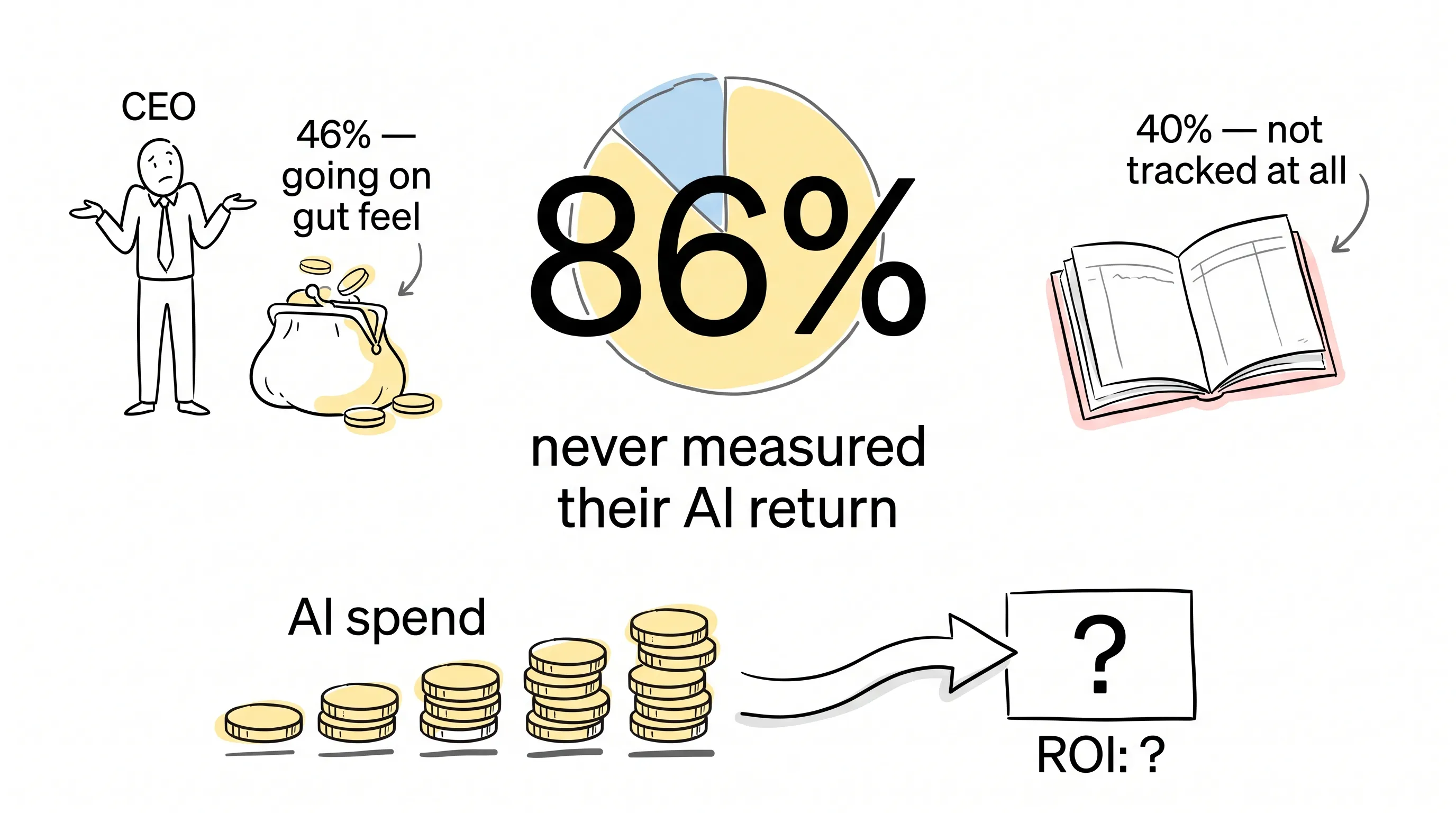
86% of CEOs have never formally measured the return on their AI investment.
46% go on gut feel. 40% don't track it at all.
The money went out. Nobody counted it back.
You might be thinking: maybe everyone's spending so little that keeping books on it isn't worth the trouble. Not the case. Over the past twelve months, 69% of companies spent less than $50,000 on AI — essentially flat versus last year. The money keeps flowing out; the ledger stays unbalanced. And here's the part that stings: in last year's survey, 62% of respondents already admitted they couldn't calculate their returns. A year later, the spending hasn't slowed, and the accounting still hasn't caught up.
Last Year, Everyone Panicked over "What Should We Do." This Year, Everyone's Stuck on "The Pipes Won't Connect."
Where this report really earns its keep is the year-over-year comparison.
Midway through last year — the 2025 round — the survey covered 164 CEOs. The top three challenges back then were all variations of "we don't know what to do": can't separate hype from reality (45%), can't settle on a roadmap (43%), can't pick the first project that will actually pay off (42%). 72% of companies were still watching from the sidelines, still piloting.
A year later, the wind has shifted. The companies still on the sidelines? Down to 26%.
And those three big challenges? They didn't disappear — they leveled up. This year's number-one blocker is "our data isn't ready and our systems won't connect" (35%); number two is "we lack the people who can actually do the work" (27%).
Put plainly: last year's question was "is AI even worth using?" This year's question is "can my pipes even handle AI?" That's not a step backward. That's progress. When a man's worry shifts from "should I work out?" to "my home doesn't have a gym," it means he has already decided to train.
Interestingly, the "pipes" problem barely fades as companies mature. For companies that just bought their tools, it's the top blocker (35%); for companies that have already wired AI into their business processes, it's still the top blocker (37%).
The bottleneck was never AI. It's the pipes — and the people standing next to them.
One real-estate CEO among the respondents left a line that stuck with me: "Too many tools, too many paths. I don't know which one to take."
Lubricant — and Gears
One distinction in the report really gets the blood pumping: lubricant, and gears.
What's lubricant? You buy AI and have it help write emails, summarize documents. The old work gets a little faster, and nothing about the process changes.
What's a gear? AI takes over an entire stretch of process and turns end-to-end on its own, with no one standing by to yell "go."
Of the 35% of companies that bought enterprise-grade tools (think Copilot, ChatGPT Teams), most are still using lubricant. Among that group, only 2% have formally run the numbers, half haven't even set up results tracking, and only 53% have deployed deeply enough that failure could actually surface. The tools came home. The work didn't happen.
The 37% that wired AI into specific processes? Those are the ones starting to build gears.
The money hides in the gears.
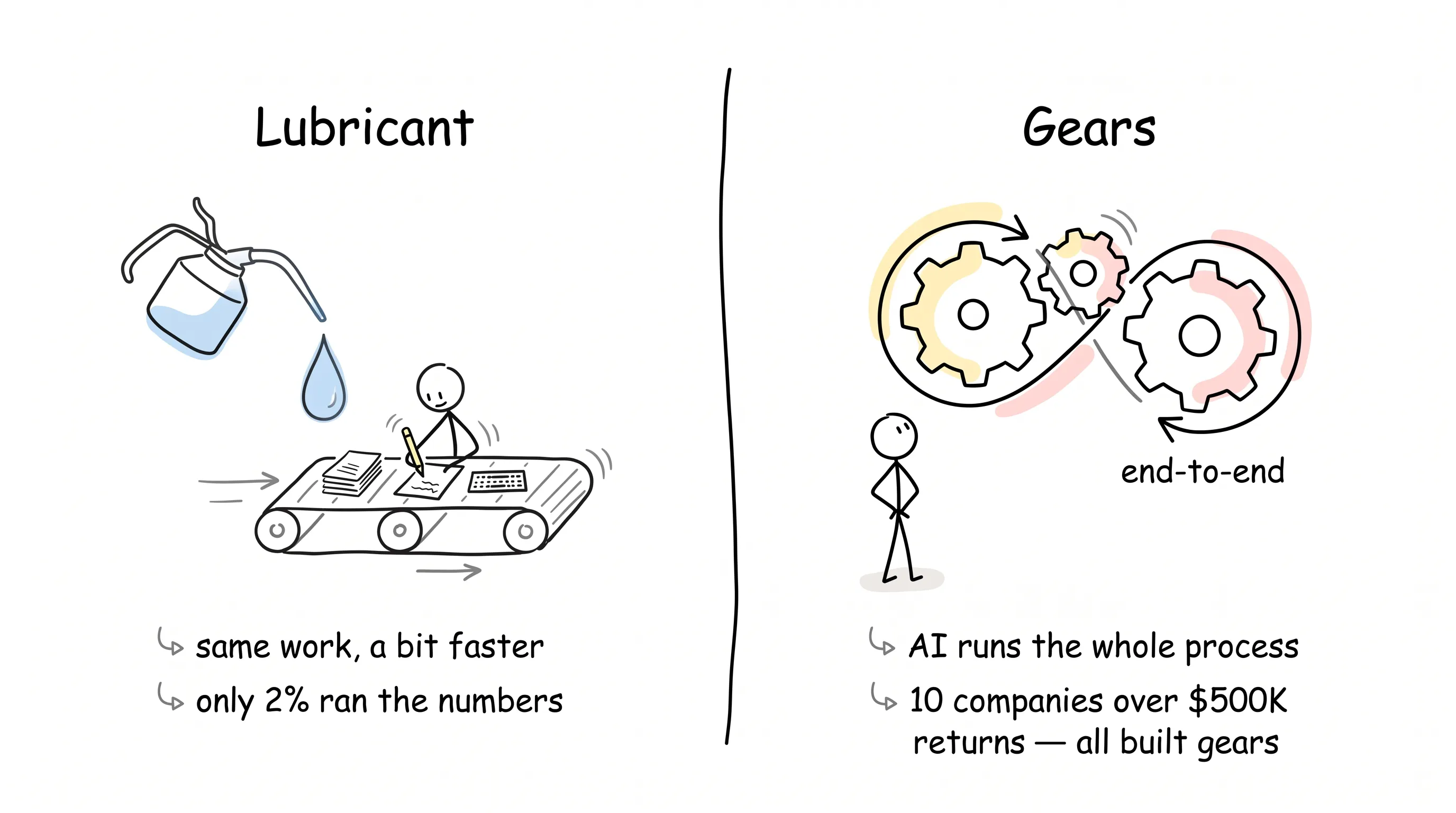
The evidence is rock solid. Among these 134 companies, 10 reported verifiable AI returns above $500,000. Without exception, every one of those 10 had crossed beyond the "exploration" and "tool-buying" stages into process-level or autonomous-level maturity. Not a single one was still at the "use AI as a chatbot" stage.
Not one.
A financial-services CEO among the respondents said AI has already automated most of an analyst's work, at speeds that improve by orders of magnitude. "I'd estimate our return is at least 20 to 1."
You can't chat your way to half a million dollars.
Failure Isn't the Opposite of Progress. It's Progress's Shadow.
Now, about failure.
54% of surveyed companies have botched at least one AI project. And the more they spend, the more they fail: among companies with annual budgets under $10,000, the failure rate is 37%; over $50,000, it's 75%.
If you're alarmed reading this — don't be. Bigger budgets don't buy more failure — they buy more attempts. Try more times, and you'll fall more times.
Here's a starker contrast. Companies that set up a dedicated AI role have a project failure rate of 68%; teams led personally by the CEO, 49%. Looks like "the professionals showed up and things got worse," right? Now look at the other half: 58% of companies with a dedicated AI role have already reached process-level maturity; among CEO-led teams, only 36%.
Failure and progress arrive holding hands.
So why do they fall? Taking on too much at once (33 mentions) ranks first; data that isn't ready (28 mentions) ties with "never defining what success looks like" (28) for second. Further down: dragging on so long the momentum dies (20), internal resistance (18), vendors overselling (15).
Stare at that list for a second. Doesn't it look like every failed ERP rollout and CRM migration from years past?
Exactly. What kills AI projects has never been the technology. It's project management.
That's why I wholeheartedly endorse the report's recommendation: don't open with "let's automate our sales process." That's not a project — that's a wish. AI has to be sliced into atomic units: one trigger, one task, one output. An email came in, the CRM got updated; a purchase order was submitted, the line items got verified. Stack the atomic units one by one, and eventually the stack is a process. Try to swallow a whole process in one bite, and what you get is a stalled, half-finished mess.
The Money Went to the Places That Don't Hurt
Here's a misalignment that should send every owner to the mirror.
Among surveyed companies, 68% use AI for content creation, 57% for internal knowledge search, and 50% for writing code. All good work — and all light work.
Yet when the CEOs themselves name the most labor-draining repetitive tasks, what do they say? Order processing (17%), data entry (17%), quoting and invoicing (14%), report reconciliation (14%).
How concrete is the mismatch? Among companies that named order processing as their sharpest pain, only 25% have actually put AI into their operations. Among those that named reporting as the pain point, only 32% use AI in financial analysis.
Everyone is automating the easy places and leaving the painful ones for later.
Why? Because the most painful places are precisely the hardest to connect. Orders, reports, quotes — all of them require plugging AI into the systems where the company's real business actually runs, and those pipes are hard to connect. So people reach for the low-hanging fruit first.
There's nothing wrong with picking low-hanging fruit; content creation is a fine starting point. But if you never leave the low-hanging fruit, what you're optimizing is comfort, not profit.
The report has a concept for this: the linear ceiling. If doubling your revenue would require doubling your customer service, operations, or sales headcount, then that function is your ceiling. AI dollars should land there first. It hurts the most there — and it's worth the most there.
Before You Act, Ask Two Questions
So what do you do about "the data isn't ready," the number-one blocker? The report offers a self-check. It's two questions.
Question one: Can AI connect? Is there an API, a webhook, a working pipe?
Question two: Can AI read it? Can it make sense of what's sitting in those systems?
The mainstream SaaS tools you use will likely pass both questions. The ERP that's been chugging along for ten years, and the Excel file on some colleague's desktop, will likely fail both. Lay out your whole stack of systems, score them one by one, and start where every light is green.
By the way: don't assume big companies have this figured out. In this report, companies with revenue under $5 million hit process-level maturity 54% of the time; above $500 million, only 33%, with the middle of the market clustered around 38% to 40%. The sample at the top is thin, so treat the direction loosely — but the trend is real: bigger ships didn't get across the river first, and size didn't buy a head start.
Back to That Dinner
That evening, I told my friend the story of these 134 survey responses, then asked him: so when do you plan to start counting your returns?
"Next week," he said. "One thing first: for every AI tool, write down who it saved time for, and how many hours — line by line."
"Good," I said. Keeping books isn't glamorous, but it works. Of the 14% of companies in the report that formally count their returns, 80% have already wired AI into their processes; 65% of them have stumbled, and they keep counting anyway. All 10 companies with returns above $500,000 are counting their books. And the batch that bought tools but never tracked results? Half of them don't even know whether they've failed.
Measurement isn't an exam to pass. It's a thermometer. Keep taking the temperature, and the fever breaks.
His prescription is one the report has already written out: don't overreach, slice into small units, find where it hurts most, and connect the pipes first.
Here's hoping you get your AI ledger balanced soon.
Continue reading
Related articles

Cross-Border Business: Time to Upgrade Your AI Toolbox
A learn article explaining how AI tools help cross-border e-commerce sellers clear five hurdles: language, regulation, logistics, payments, and fraud. It outlines a five-compartment toolbox, a five-step adoption path, and metrics such as conversion rate and CLV, while cautioning against over-reliance on AI.

AI Is Taking Over the Dirty Work of Social Media Marketing, One Task at a Time
This learn article outlines four social media marketing tasks AI can handle — audience analytics, content drafting and design, ad targeting and creative testing, and spam moderation — and cautions that taste, judgment, and data security remain human responsibilities.

AI Is Already This Good — Why Is Your Social Media Marketing Still Pure Manpower?
An overview of 18 AI tools for social media marketing, organized into six categories covering audience research, content creation, scheduling, comment and DM handling, ad management, and visual production, plus notes on personalization, prediction, and emerging trends.