
133 Million People Got There First — and the Rules of Marketing Are Being Rewritten
An overview of generative AI's impact on 2026 marketing: consumers ask AI first and verify via search, so brand visibility now involves earning AI citations (GEO) alongside Google rankings, while marketers apply AI to audience targeting, creative testing, and performance measurement.
A few nights ago I was having dinner with friends. Trying to pick a restaurant, one of them pulled out his phone and asked ChatGPT first.
Why, I asked.
"Because it's easy," he said. "The AI just tells me which place is good."
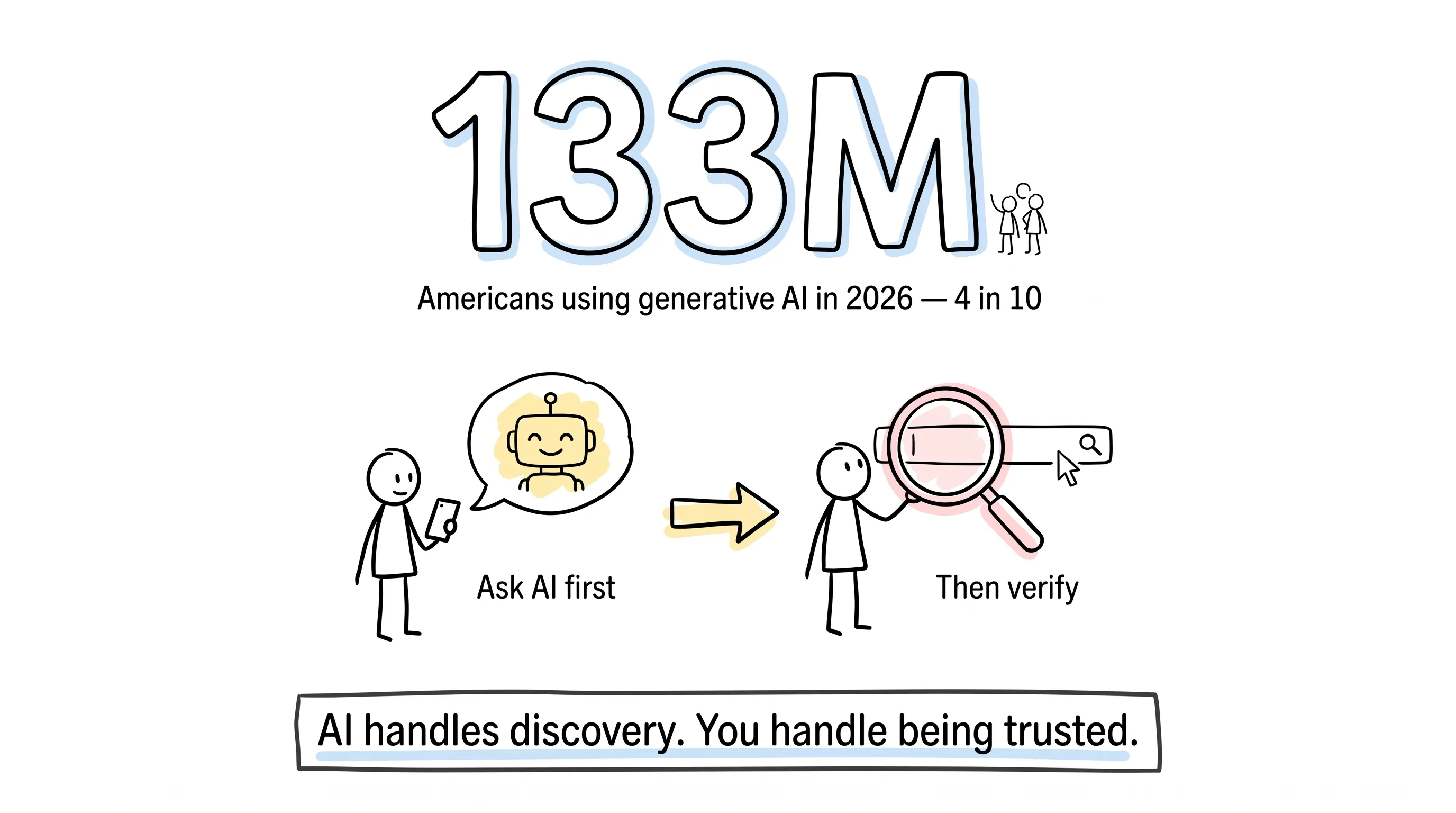
Then I watched him do something interesting. The moment he had his answer, he opened Google himself, ran the search, and double-checked.
"You already asked the AI," I said. "Why search again?"
"It said it," he replied. "I still want to verify it myself."
In that moment it hit me: this one little ritual pretty much distills the relationship between ordinary people and AI in 2026 — we can't live without it, and we don't fully trust it.
And if you're in marketing, this matters to you a great deal.
Start with a Number
In 2025, 121 million people in the United States used generative AI — 35.8% of the population.
EMARKETER, the market research firm, forecasts that the number will climb to 133 million in 2026, or 39.2%.
How big is 133 million? Roughly this: four out of every ten Americans use it.
From the day ChatGPT launched in November 2022, this technology needed less than four years to cover ground that other technologies might not manage in a decade.
And notice the growth rate: 9.8%.
What does 9.8% tell you?
That the explosive phase is over. Explosive growth comes in jumps of dozens or hundreds of percent. 9.8% means everyone eager for an early taste has had it; what's left is the mainstream, walking in steadily, one person at a time.
Once nearly 40% of people use a technology every day, it stops being news and becomes air.
What is air? The thing you don't discuss every day, but live inside every moment.
So the question "should we use AI?" is no longer up for debate in 2026.
The only question left is how to use it well.
What Is Generative AI?
What is generative AI?
AI of the past answered true-or-false questions. Show it a photo, and it tells you: that's a cat. Or: not a cat.
Generative AI answers open questions. You give it a line, and it writes you a piece of copy, draws an image, or cuts a video on the spot.
It has read so much that it has learned what most likely follows any given sentence — and then it composes that line for you.
Every tool you hear about daily does exactly this. For chat: ChatGPT, Google's Gemini, Anthropic's Claude. For images: Adobe Firefly and Midjourney. For video: Runway. ChatGPT alone has more than 900 million weekly active users, according to tech media outlet The Information.
So what does this mean for marketers?
This: generative AI isn't plugged into one stage of marketing. It's plugged into every stage. Finding your audience, generating ideas, producing content, measuring results, search — all of it.
How Hard Are Marketers Using It?
Look at three numbers.
The first, 79%. In 2026, 79% of marketers plan to increase spending on AI-generated creator content. In 2023, that number was 70%. Nine points in three years. That's research from Influencer Marketing Factory.
The second, first place. What do brands and agencies actually use AI for most? Finding audiences and segmenting them. In a survey by IAB, the advertising industry body, that's the number-one use case.
The third, one half. Half of buy-side marketers (the brands and agencies that buy media) are rolling AI into performance measurement. Leading the charge are data and analytics teams, present in 69% of organizations. That's from IAB's State of Data 2026 report.
Sit with those three numbers for a second.
The ones adding budget, the ones targeting audiences, the ones measuring results. Onstage and backstage in marketing, AI is now in both.
But every story has a flip side.
What Do Consumers Think?
The good news first.
68% of consumers view generative AI favorably. In 2024, that number was 62%.
Marketers are even more optimistic than consumers. 75% hold a positive view, up from 68% the year before. That's from Kantar's 2025 Media Reactions report.
Everyone, it seems, is growing more accepting of this technology.
Now the bad news?
56% of internet users worry that AI will make online content less and less trustworthy. That's from EY's research.
And nearly a third of consumers see AI as a negative disruptor in the creator economy, according to a survey by Billion Dollar Boy. Content creators are getting a little rattled.
The most interesting signal, though, is still that friend's move from the start of this piece.
Ask the AI first. Then verify with Google.
What does that move tell you?
Consumers aren't refusing to use AI — they just don't take it fully on faith.
He is happy to let AI lead the way, but he keeps the right to glance back at the road signs.
And your opportunity sits right here: after AI has brought him to your door, will that one glance back land on something real?
The Most Painful Part: the Rules Haven't Caught Up
60% of US advertising professionals say accuracy and transparency are their biggest concern about adopting AI. IAB's data.
Afraid of what?
Afraid of AI talking nonsense with a perfectly straight face.
Generative AI has a defect the industry calls hallucination. In plain language: it makes things up. Convincingly, and with total confidence. An invented selling point in your copy, a fabricated spec on your product page — put that into an ad, and it's an incident. What consumers see is a fake ad.
57% of consumers explicitly say they worry about AI-generated fake ads. Kantar's survey.
But more alarming than hallucination is another set of numbers:
Only 37% of marketers have AI governance clauses written into their vendor contracts.
What does that mean?
Most companies have invited AI through the door without getting it to sign a code of conduct. How the data will be used, who reviews the content, who's accountable when things go wrong — none of it is agreed upon.
The tools are on board; the rules are still standing on the platform.
Technology isn't scary. What's scary is technology running ahead of the rules.
Search Is Being Rewritten
Back to my friend.
He asks the AI first, then searches Google. Have you considered what that means from a brand's perspective? Half of the discovery path has changed.
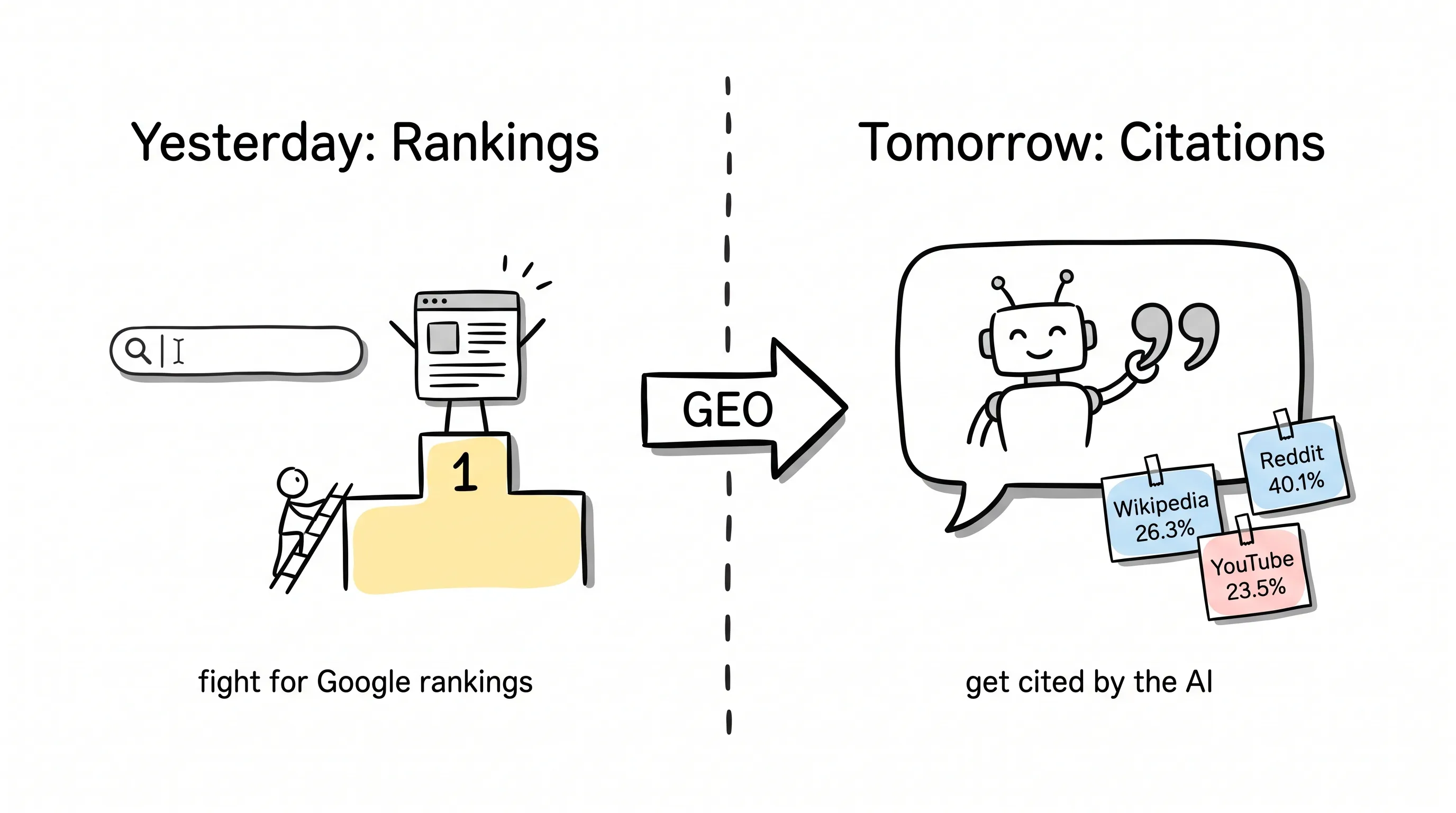
Consumers used to discover brands mainly through search, so everyone poured effort into SEO, fighting for Google rankings.
Now there's a new front door: asking the AI.
Which raises the question: who does the AI cite?
Ahrefs, the SEO toolmaker, has run the numbers: only 8% of ChatGPT's citations come from pages in Google's top 10. Gemini does slightly better, at 8.6%. Perplexity leans hardest on search engines, at 28.6%.
Then look at the sources AI cites most. Semrush's global data: Reddit, 40.1%. Wikipedia, 26.3%. YouTube, 23.5%.
Yes — more than forty percent of all citations going to a forum.
See the pattern? The AI doesn't much care where your website ranks. What it loves to cite is real people talking, public knowledge, and video.
In other words, your Google ranking and the AI's willingness to mention you are two different things.
So should you switch lanes now? No need to panic. AI's share of total digital discovery time is, so far, just 3.3%.
Still tiny. But the direction is unmistakable.
Hence the new discipline springing up across the industry: GEO, Generative Engine Optimization. The old goal was to get seen by Google. The new goal is to get cited by the AI.
Yesterday you competed on rankings; tomorrow you compete on citations.
What Is Agentic AI?
One more term you've surely heard: agentic AI.
What is agentic AI?
Generative AI answers one question at a time. Like an intern: you brief him once, he hands in a draft.
Agentic AI takes a goal and then breaks it down, executes, and carries it all the way through on its own. More like a project manager: from audience targeting to bidding to the post-mortem report, it runs the whole pipeline end to end, no babysitting required.
In advertising, what would agents most likely take over first?
Performance reporting, and the day-to-day operations of the customer journey — among the most common scenarios in research by Coleman Parkes Research and SAS.
The industry is writing rules for this too. A protocol called AdCP, the Ad Context Protocol, has already emerged, specifically defining how AI agents talk and collaborate with each other.
This one hasn't hit its breakout moment yet.
But there's little doubt about the direction.
From Fear to Fluency
On the creation side, the mindset is shifting too.
Two years ago, agencies spent their meetings asking: will AI take our jobs?
Now, EMARKETER sums up the shift in a phrase I especially like: from fear to fluency.
PepsiCo has put generative AI to work across its entire creative process. Agencies like Edelman and R/GA have embedded AI tools into their daily production lines, using them as naturally as Photoshop.
Individual creators are using them too. Influencer Marketing Factory's data: 24.7% of creators use AI for editing, 21% for ideas, 17.2% for scripts and copy.
And the toolbox is fully stocked. Text is ChatGPT; images are Adobe Firefly, Midjourney, Freepik; video is Runway — and ByteDance has Seedream.
But the real killer on this page isn't "using AI to draw pictures."
It's this line: automatically generate ad variants, wire them to real-time performance data, and learn while you run.
What does that mean?
In the past, you'd make one creative asset and, to test which version worked, build three variants, launch them by hand, read the numbers by hand, and get one round of conclusions a week.
Now, the machine generates dozens of variants automatically, wired to live performance data — whichever one pulls ahead, it keeps generating in that direction.
Guessing your way from version to version and compounding with every iteration are two different businesses.
That volume is beyond human hands. That is generative AI's real power on the creative side.
For 2026, Drive Three Piles Deep
So what do you actually do?
First, some background. In IAB's State of Data 2026 report, 75% of buy-side executives admit: marketing measurement is currently falling short of expectations. And IAB has done the math: through better targeting, measurement, and optimization, AI could unlock $26.3 billion in media investment.
The money is there. What's missing is the playbook.
My advice: in 2026, do three things.
- Feed your data well.
AI's ceiling is your data's floor. How well generative AI performs depends entirely on the data you feed it. Before adopting AI, audit your first-party data first: is it complete? Scattered across how many systems — and do they talk to each other?
- Build AI literacy.
Note: this doesn't mean everyone becomes a prompt engineer. Creative teams train two things: the quality of their questions, and conceptual thinking. The machine can turn out a hundred drafts, but which draft is right — that judgment stays with humans. Ops teams train another thing: translating the insights AI surfaces into measurable results.
- Set the rules before you step on the gas.
Who reviews AI-generated content? How should the AI clauses in vendor contracts be written? How is data used? Get these three answers down in writing before you scale.
Reverse the order, and you've pencilled an accident into your schedule.
Finally, Back to That Dinner
Back to the friend from the start.
He asks the AI first, then verifies with Google.
That seemingly redundant act of "verifying" is the entire instruction manual for marketing in 2026:
Let AI bring you in front of the consumer. Then, with something real, win the glance back.
AI handles discovery. You handle being trusted.
Here's to your brand becoming, one day soon, the one consumers still choose after they've double-checked.
Continue reading
Related articles

Cross-Border Business: Time to Upgrade Your AI Toolbox
A learn article explaining how AI tools help cross-border e-commerce sellers clear five hurdles: language, regulation, logistics, payments, and fraud. It outlines a five-compartment toolbox, a five-step adoption path, and metrics such as conversion rate and CLV, while cautioning against over-reliance on AI.

AI Is Taking Over the Dirty Work of Social Media Marketing, One Task at a Time
This learn article outlines four social media marketing tasks AI can handle — audience analytics, content drafting and design, ad targeting and creative testing, and spam moderation — and cautions that taste, judgment, and data security remain human responsibilities.

AI Is Already This Good — Why Is Your Social Media Marketing Still Pure Manpower?
An overview of 18 AI tools for social media marketing, organized into six categories covering audience research, content creation, scheduling, comment and DM handling, ad management, and visual production, plus notes on personalization, prediction, and emerging trends.