
11 p.m., and still adjusting Meta and Google budgets by hand?
A long-form article on how AI agents can take over repetitive ad operations for agencies, covering automated bidding, budget shifting, creative fatigue monitoring, report automation, a 90-day rollout plan, and the changing role of media buyers.
Last week, I went to visit an old friend who runs an ad management agency. At 7 p.m., every light in their office was still on.
He was glued to a client's Meta ad account. CPA (cost per acquisition) had spiked that afternoon, and he was manually pulling budgets back — and while he did, he told me: this was already the third time this week.
I said, don't you have three media buyers?
He said, they are. One was adding negative keywords to another client's Google Ads account. One was writing three weekly reports. And one was going through creative data, judging which ad was about to burn out.
Notice anything? Those three tasks have one thing in common: not one of them is strategy. They're all operations.
After we talked that day, the whole way back I kept chewing on one question: in the ad-buying trade, where does human time actually go — and is it worth it? Today, let me tell you what I worked out.
First, let's run the numbers
What is the ceiling on a skilled media buyer's capacity?
Here's a rule of thumb that circulates in the industry: one person comfortably manages $200K to $400K in monthly ad spend. Push above that, and reactions start to lag and performance starts to slip.
This isn't a talent problem, it's a biology problem. People need to sleep, attend meetings, take vacations. The CPA spike in a client account at 3 a.m.? Your media buyer doesn't see it, because he's asleep.
But client demands keep rising. Finer targeting, fresher creatives, prettier reports, ideally a weekly call on top. Client expectations are an exponential curve; headcount is a constant.
What to do about the widening gap?
Ryze put a number on it, in an analysis covering the operations of 500-plus agencies: roughly 47% of billable hours go to mechanical work — adjusting bids, moving budgets, watching data, assembling reports. Nearly half of what's being sold is "hands," not "brains."
And on the other side, today's mainstream AI ad tools: a single agent can simultaneously watch $2 million-plus in spend, across hundreds of campaigns, all year without rest.
On one side, a $400K ceiling. On the other, a $2M floor. That gap is why, over the past year or two, large numbers of agencies started handing daily operations to AI.
What is AI-managed, actually?
First, let's get one thing straight, so there's no misunderstanding.
AI management is not a tool that pulls data for you and draws charts. Tools are for you to look at; the decisions are still yours.
AI management means an agent makes decisions in your place: it adjusts bids, it moves budgets, it pauses fatigued creatives, it writes the reports that need delivering. You set goals and rules; execution is its job.
Quite a few products on the market already do this. Take a company called Ryze AI, which specializes in automated management of Google Ads and Meta campaigns. By its own reported numbers, it has 2,000-plus clients, manages more than $500 million in spend, across 23 countries. Vendor-reported numbers — take them as an order of magnitude, nothing more. But that magnitude at least shows someone has walked this road already; it's not a concept.
So what is the agent actually doing in your place? I've grouped seven kinds of work into three piles. Let me walk you through them.
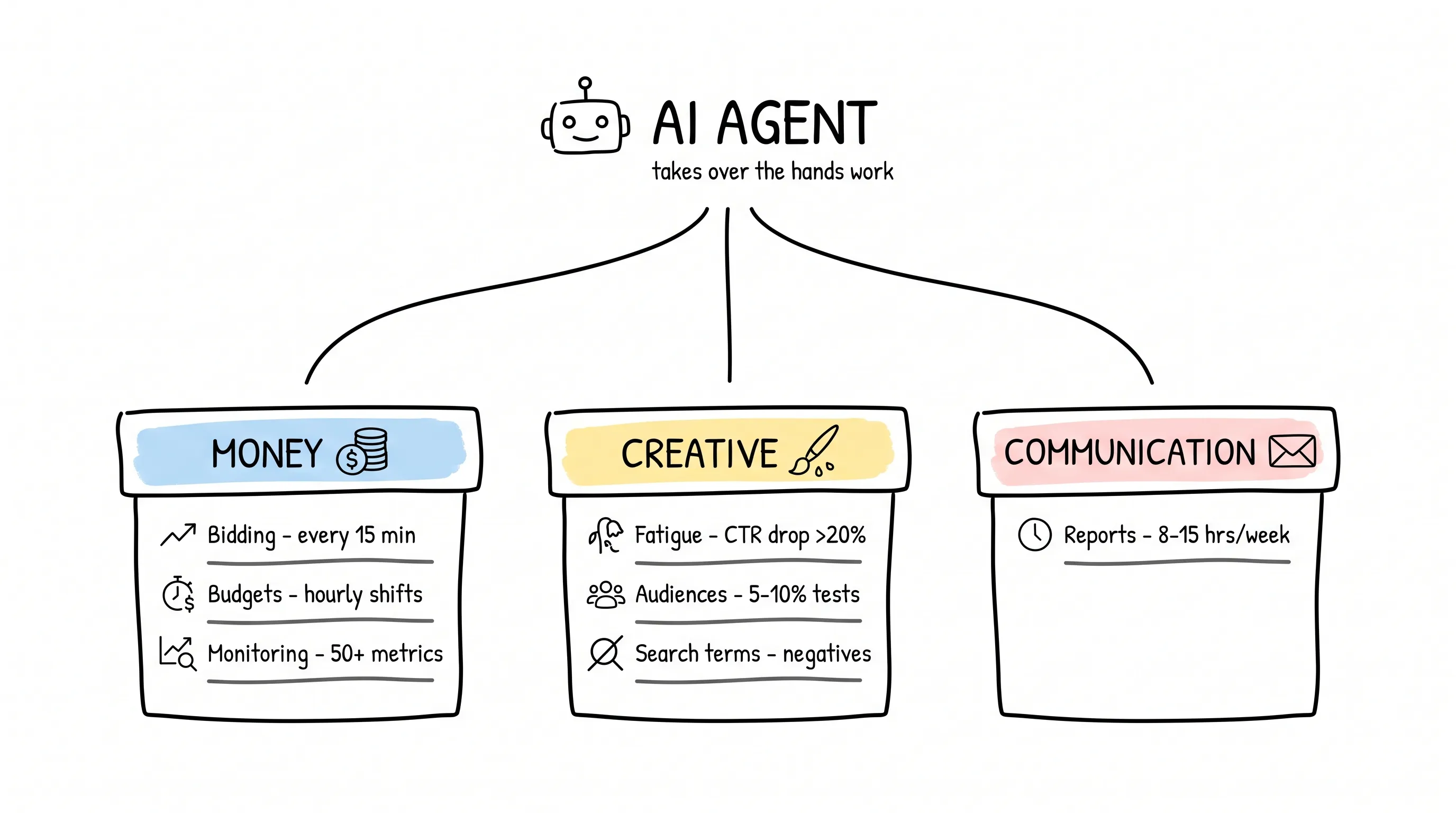
Pile one: the money work
Bidding is the most typical one.
A human media buyer adjusts bids two or three times a day, at best — and that's pushing it. AI looks at conversion data, cost trends, and the auction environment every 15 minutes, and moves whenever it should. 96 times a day against a human's two or three: 96 times the diligence. Within 15 seconds of a conversion event, it's already reacting.
Per Ryze's numbers, clients who switched on automated bidding saw CPA drop 25% to 35% on average in the first month. Apply the usual discount to the vendor numbers, but I believe the direction: bidding is a contest of reaction speed, and humans have no chance on speed.
Budgets are the second.
How do humans do budgets? A glance at the weekly meeting, a rough shuffle here and there. The problem is, the best moment to move money often hides between two weekly meetings — miss it, and it's money spent for nothing.
AI's approach: compute the marginal ROAS (return on ad spend — here, the return on the next dollar of budget) of every campaign and every ad group, every hour. Wherever spend is underperforming, move the budget immediately to wherever conversions are good. Campaigns whose CPA exceeds 150% of target get auto-paused outright, no discussion. With the whole system running, account-level ROAS rises 20% to 40%.
The third is monitoring.
CPA spikes, budgets burning out ahead of schedule, creatives rejected by the platform — with these three kinds of incidents, every hour of delay is real money. AI's approach is to hang 50-plus metrics under monitoring, and the moment any account shows a statistical anomaly, the alert fires immediately.
While you're asleep at midnight, it stands guard.
Pile two: the creative work
Creative fatigue is an old problem, and a big one.
Run one creative long enough and viewers go numb; click-through rate slides down, costs climb up. This "fatigue drag" eats 30% to 50% of potential performance. Watch creatives by hand, and by the time you spot something wrong, a chunk of budget is already spent.
AI watches click-through trends across 7-day, 14-day, and 30-day windows. The moment the drop passes 20%, it auto-pauses the old creative and promotes the backup. Where an A/B test is due, it runs until the results are statistically significant — no conclusions drawn on gut feel.
Audiences are the second.
Testing a new audience manually means locking up weeks of budget and tiptoeing the whole way. AI's approach: first put 5% to 10% of budget into a micro-test, watch conversion quality and lifetime value: scale winners immediately, kill losers immediately.
It also handles a chore humans can't be bothered with: when it finds two campaigns with highly overlapping audiences, it reminds you to merge, so your own campaigns don't fight each other for inventory and push up CPM (cost per thousand impressions).
The third is search terms and placements.
In a Google Ads account, 20% to 30% of budget goes, year in and year out, to search terms unrelated to the business and to low-efficiency placements. AI reads the search terms report continuously; when it finds irrelevant terms, it adds them to negative keywords automatically; when it finds weak placements, it lowers bids automatically.
Everything saved is pure net profit.
Pile three: the communication work
This pile takes the least skill, but agencies resonate with it most.
Writing client reports. A mid-size agency spends 8 to 15 hours a week assembling them. Pulling data, reconciling numbers, screenshots, layout, writing conclusions — all rote work, and it all grinds people down.
Plug in the data feeds once, and AI consolidates multi-platform data automatically, analyzes trends automatically, writes the executive summary automatically, even fits the client's brand colors and logo. You only need to give it a final read.
The advice I gave my friend that day: start with reports — nothing else needs to hurry.
He asked why.
I said, because this one pays back fastest and touches no buying decisions at all. Trust is something you build starting where the risk is zero.
But don't rush to hand everything over
At this point, you might be thinking: what are we waiting for — full automation tomorrow?
The opposite, in fact. I've seen quite a few cases, and the ones that failed almost all tripped on the same move: going all-in at once.
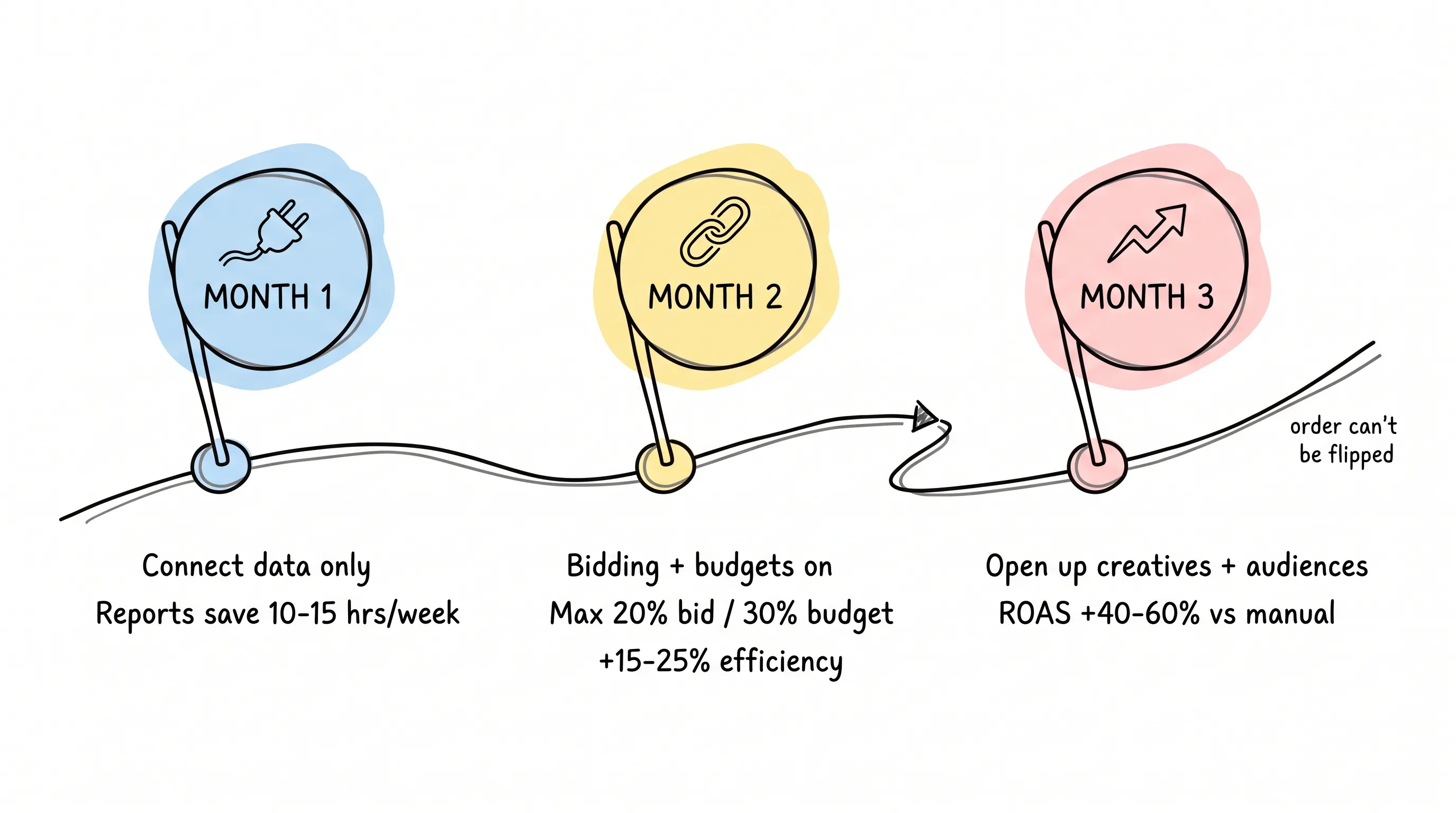
The dependable rhythm is 90 days, in three steps. This rhythm was ground out of deployments at 200-plus agencies.
Month one: connect data only, touch nothing. Bring all client accounts onto the platform, set up baselines, let the team get familiar with the new process. The payoff shows up within the month: report automation alone saves 10 to 15 hours a week.
Month two: turn on automated bidding and budget shifting, but with the chains on. Two hard constraints: bid adjustments no more than 20% per day, and no single budget move over 30% of a campaign's total. Watch the data daily, tune parameters as you run. This stage typically shows 15% to 25% efficiency gains — all of it waste human eyes can't see but AI spots at a glance.
Month three: then open up creative rotation, audience expansion, and cross-platform coordination. By this point the team has a feel for how the AI judges, and they can loosen their grip. After the three steps, per the agencies that ran the full sequence, overall ROAS can sit 40% to 60% above a purely manual baseline.
The order can't be flipped. Trust is accumulated step by step, not delivered in one shot.
The client hurdle is actually harder than the tech
Technical problems come with manuals. Human ones don't.
When clients hear their account will be handed to AI, the first reaction is almost always: what if things spin out of control? Will quality drop?
So what do you do? Here's the move I find most elegant.
In the first two weeks, hold one 60-minute meeting: lay out the logic of AI management, show real data from other clients, and take each of the client's specific concerns head-on, one by one. That single meeting dissolves 80% of the fence-sitting clients.
Then comes the key move: let the AI watch first and do nothing.
Run two to four weeks, then produce a report for the client: during this period, which actions the AI would have taken, the evidence behind each one, and the projected impact of each. Looking at this "changed nothing" report, the client reaches the conclusion on their own: this thing watches closer than a person does.
At weeks five to eight, start rolling out low-risk automation: reports, small bid moves, obvious budget shifts, with a weekly action list for the client, each action tagged with performance data. By weeks six to eight, most clients flip and start pushing you: can you switch it all on?
Interesting, right? Just like that, the initiative changes hands.
Every month after, the report carries a few lines of AI-specific metrics: how many optimization opportunities found this month, how much manual labor saved, who gets credit for the lift. The comparison baseline is pre-integration data — same market conditions, same budget levels. With this ledger laid in front of the client every month, renewals and budget increases take care of themselves.
Now, the full ledger
Take a mid-size agency with 20 to 30 clients and $2 million in annual spend. Here's how the ledger runs on Ryze's numbers.
Money saved: $120K to $180K a year in labor, $30K to $50K from report efficiency, $15K to $25K from fewer mistakes. Total: $165K to $255K.
Money earned: improved client ROAS brings $200K to $400K; freed-up people going after new clients are worth $150K to $300K; with results better, service fees can rise too — another $50K to $100K. Total: $400K to $800K.
And the tool's cost? $15K to $30K a year.
Set income against cost, and the vendor says year-one returns are ten- to twenty-fold. Don't take that multiple too seriously — saved labor doesn't necessarily turn into cash right away. But one block of this ledger, I believe, is real money: per-person productivity.
A media buyer who used to independently manage $400K in monthly spend can manage $1.2M-plus once paired with AI. The same team can take on two to three times the clients.
One agency in Ryze's customer stories went from managing 25 clients to 55, without hiring a single person, and client performance rose rather than fell — all within 90 days.
Saving time is the small ledger; doubling per-person productivity is the big one. The small ledger decides whether this year feels comfortable; the big one decides whether you're still at the table three years from now.
Five pitfalls to know before you start
The first pitfall: team resistance. The line media buyers most dread hearing is: am I going to be replaced? You have to make it clear that what AI takes away is repetitive operations; it can't take strategy or client relationships. Pave an "AI-augmented role" path for the people willing to transform — agencies that do this well reach 90% team buy-in within two months.
The second pitfall: dirty data foundations. Old accounts have conversion tracking of every imaginable variety, with event tracking riddled with gaps. Turn on automation without cleaning it up, and the AI is driving blindfolded. Reserve 2 to 4 weeks for data cleanup — that's time you can't skip.
The third pitfall: attribution disputes. Performance is up — is it the AI's credit, or did you just catch high season? Set up multi-period pre-integration baselines ahead of time, and set up a control group wherever you can. If the numbers can't be made clear, everything downstream turns into disputes.
The fourth pitfall: moving too fast. Let me repeat myself: most failures come from "switching everything on at once." Return to the 90-day rhythm — slow is fast.
The fifth pitfall: platform limits. Google's and Meta's APIs both have rate limits and data latency; not every operation can execute in real time. When choosing a tool, treat interface stability and depth of platform integration as hard criteria.
So will media buyers lose their jobs?
I suspect you saw this question coming.
My judgment: no. But one kind of media buyer will get weeded out.
What AI takes away is the "hands": adjusting bids, moving budgets, watching data, writing reports. Machines genuinely do this work better than people — like it or not.
What can't be taken is the "brains": what to push this quarter, which markets to tilt budget toward, what the client will need next, which direction to take the creative. These judgments rest on understanding the business and on trust built with people — AI can't supply them.
So the real change is: media buyers who can only execute will see their value slide all the way down; media buyers who understand strategy and can explain things clearly to clients become more valuable with AI behind them. Same title, wrong direction, completely different ending.
For agencies, the math adds up to serving more clients, not cutting staff. The same people, managing two to three times the clients, earning two to three times the money.
Finally, back to my friend
That night at 11 p.m., he sent me a message: report automation is live — no overtime tonight.
He said Wednesday nights used to be set in stone as report night. Now that night is free; he booked a strategy session with a client, and the conversation was no longer about whether the numbers were right — it was about where to aim next quarter.
AI has taken over the "hands" work, so people can finally do the "human" work.
In the ad-buying trade, the era of competing on diligence is passing. Machines are more diligent than people — that was settled on day one. The cards left in human hands are judgment and trust.
Here's to getting your 11 p.m. back — soon.
Continue reading
Related articles

Cross-Border Business: Time to Upgrade Your AI Toolbox
A learn article explaining how AI tools help cross-border e-commerce sellers clear five hurdles: language, regulation, logistics, payments, and fraud. It outlines a five-compartment toolbox, a five-step adoption path, and metrics such as conversion rate and CLV, while cautioning against over-reliance on AI.

AI Is Taking Over the Dirty Work of Social Media Marketing, One Task at a Time
This learn article outlines four social media marketing tasks AI can handle — audience analytics, content drafting and design, ad targeting and creative testing, and spam moderation — and cautions that taste, judgment, and data security remain human responsibilities.

AI Is Already This Good — Why Is Your Social Media Marketing Still Pure Manpower?
An overview of 18 AI tools for social media marketing, organized into six categories covering audience research, content creation, scheduling, comment and DM handling, ad management, and visual production, plus notes on personalization, prediction, and emerging trends.