
10,000 Commercial Messages a Day — How Is Anyone Still Earning 457%?
First, a quick question: how many commercial messages do you think an ordinary person scrolls past in a single day?
First, a quick question: how many commercial messages do you think an ordinary person scrolls past in a single day?
Ads, push notifications, texts, splash screens, pop-ups — count them all.
In April 2026, the customer engagement platform Braze held its City x City event in London and released two studies at once. One was produced jointly with the consultancy Cowry; the other was a financial analysis commissioned from Forrester Consulting.
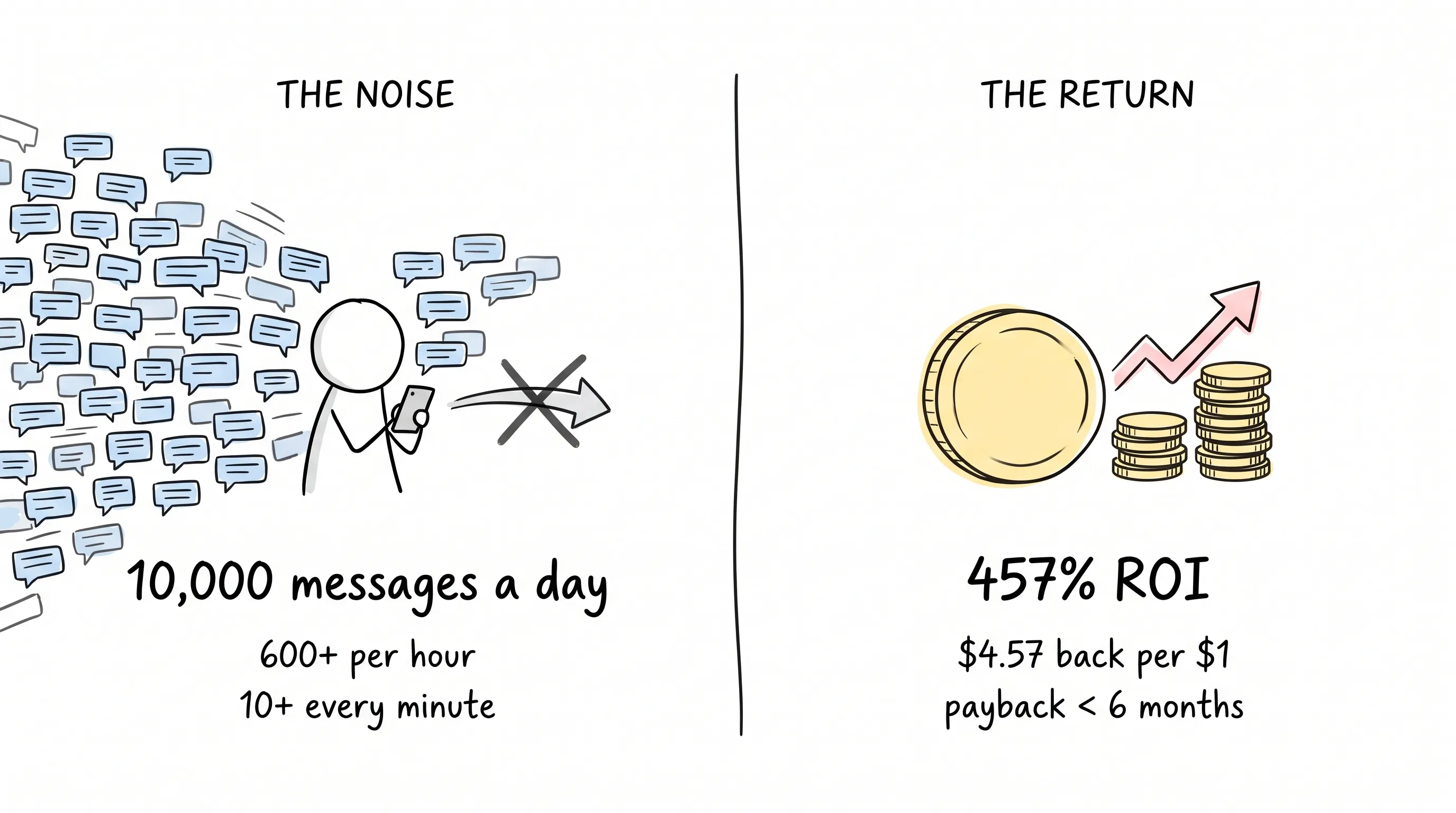
The Cowry study contained a striking number: a single consumer can be exposed to up to 10,000 commercial messages every day.
What does 10,000 even mean? Think about it: even if you're awake a full sixteen hours a day, that averages out to more than 600 messages an hour — ten or more every minute.
Your push notification is just one of those ten.
Worse still, AI has driven the cost of producing content down to nearly zero — and that 10,000 is still climbing.
By all rights, life in marketing should be getting harder by the day.
Yet Forrester's numbers came back with the exact opposite result.
457%.
According to the study, companies using the Braze platform — together with its BrazeAI Decisioning Studio — see a 457% return on investment over three years.
For every dollar invested, a net gain of $4.57.
Net present value: $23.5 million. What's net present value? It's what all the money you'll earn down the road is worth in today's dollars — $23.5 million.
And the payback period? Under six months.
Enterprise software that pays for itself in half a year. Good grief.
Here's how Forrester built the model: interview a group of real customers, assemble a representative "typical enterprise," and tally up the platform's benefits line by line.
Of course, this is research Braze commissioned, and the numbers inevitably come with a flattering glow. Fair enough. Read it, but don't lean on it.
But what's really interesting about this math is the flip side.
Put the two studies side by side and the gulf opens up: nearly everyone is pouring money into AI, but only a small handful can show measurable returns.
On one side: 457% ROI, payback in six months.
On the other: most people's money goes out and disappears without so much as a splash.
So what exactly makes the difference?
Users Will Block You Faster Than You Can Publish
Astha Malik, Braze's Chief Business Officer, put it especially bluntly.
AI-generated content, she said, can be infinite; user attention is finite; loyalty is fragile.
Three lines, and the whole predicament of marketing today is laid bare.
The cheaper content gets, the more junk there is. She even has a name for this stuff: AI slop.
Every piece of AI slop that lands in front of a user gets swiped away, muted, unfollowed. You think you're reaching people; you're actually training them to shut you out.
Users will block you faster than you can publish.
So you see — the problem was never "not enough output."
Once AI solved the volume problem, it leveled the starting line for everyone: anybody can push out ten thousand messages a day.
So what's the contest now?
Whether, out of your ten thousand, even one message gets remembered.
What Did the Winners Get Right?
What exactly did the 457% crowd do right? The study offers a few clues — let me break them down for you.
First, use data in real time. What does real time mean? A user has just looked at the same pair of running shoes three times in your app; five minutes later, what you send them is a size reminder for that exact pair — not a blast that says "everything's half off." Your first-party data is sitting right there in your systems. If you don't use it on the spot, you're sitting on a gold mine while living on gruel.
Second, embed decisioning into the journey. AI is not something to be sealed in a lab running experiments on its own; it has to live at every node of the customer journey, judging and reacting in the moment.
Third, subtract from your toolkit. The trouble with many teams isn't too few tools — it's too many. The more systems you run, the more fragmented your data becomes, and just reconciling the numbers will cost you half your sanity. Fewer fragments, faster execution.
Fourth, raise every campaign like a living system. A campaign going out doesn't mean the work is done. It should learn: run a round, read the data, make an adjustment, run again. Flyers are one-and-done; a system grows on its own.
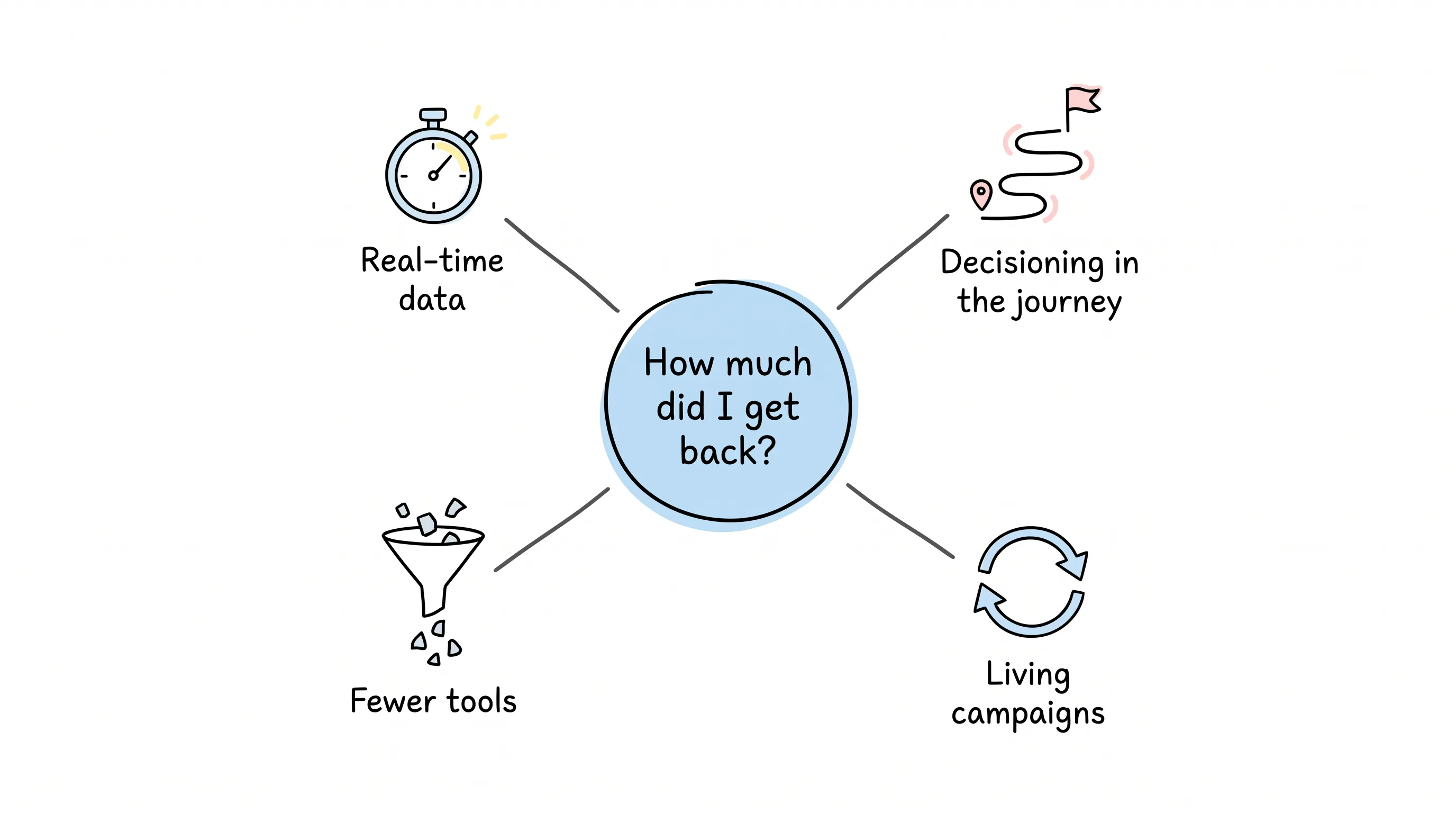
Strip all four down, and they come down to a single shift:
From "How much did I send?" to "How much did I get back?"
If You Want to Move From the Left Side to the Right
Four pieces of advice, for everyone out there pouring money into AI right now.
-
Schedule less by the calendar, play more by the signal. What your user just did matters far more than what today's date is.
-
Shore up decisioning before you pile up content. AI-written copy is hardly scarce anymore. What's scarce is the judgment of who, at which moment, should receive what.
-
Consolidate your tools. Your team really does not need an eleventh dashboard.
-
Watch outcomes, not output. Conversion, retention, revenue — these words sound old-school, but they're the only ones that will tell you whether AI is actually making you money.
Finally, Back to Those 10,000
Ten thousand commercial messages a day — that's the noise everyone shares.
Some get swiped away among those ten thousand.
Some get remembered among those ten thousand.
Same tools, same AI. The gap isn't the technology — it's the question you ask of it.
Some use AI to pile up volume; some use AI to drive results.
Here's hoping you're the latter.
Continue reading
Related articles

Cross-Border Business: Time to Upgrade Your AI Toolbox
A learn article explaining how AI tools help cross-border e-commerce sellers clear five hurdles: language, regulation, logistics, payments, and fraud. It outlines a five-compartment toolbox, a five-step adoption path, and metrics such as conversion rate and CLV, while cautioning against over-reliance on AI.

AI Is Taking Over the Dirty Work of Social Media Marketing, One Task at a Time
This learn article outlines four social media marketing tasks AI can handle — audience analytics, content drafting and design, ad targeting and creative testing, and spam moderation — and cautions that taste, judgment, and data security remain human responsibilities.

AI Is Already This Good — Why Is Your Social Media Marketing Still Pure Manpower?
An overview of 18 AI tools for social media marketing, organized into six categories covering audience research, content creation, scheduling, comment and DM handling, ad management, and visual production, plus notes on personalization, prediction, and emerging trends.