
1,400 Marketers Turned in Their Exams. The Second Half of AI Marketing Is No Longer About Who's Using It
A learn article reviewing Jasper's State of AI in Marketing 2026 survey of 1,400 marketers: with AI adoption now near-universal, competition shifts from tool usage to scaling content pipelines, governance, ROI tracking, and team maturity.
A while back, I finished up what was on my plate, brewed a cup of tea, and read a report from cover to cover.
Jasper released a State of AI in Marketing 2026 report, surveying 1,400 marketers across industries, roles, and companies of every size. Reading it, I stopped more than once to write one line on a sticky note:
The AI marketing exam has changed its questions.
What does that mean? Let me start from the beginning.
The First Half: It Was About Whether You Used It
What do I mean by the first half? The experimentation phase everyone has been living through these past few years.
You bought a tool and gave it a try. Tried it on copywriting, tried it on images, tried it on the weekly report too. If it saved you some time, you kept using it. Back then, whoever dared to use it, whoever used it first, got ahead.
And now? That advantage is gone.
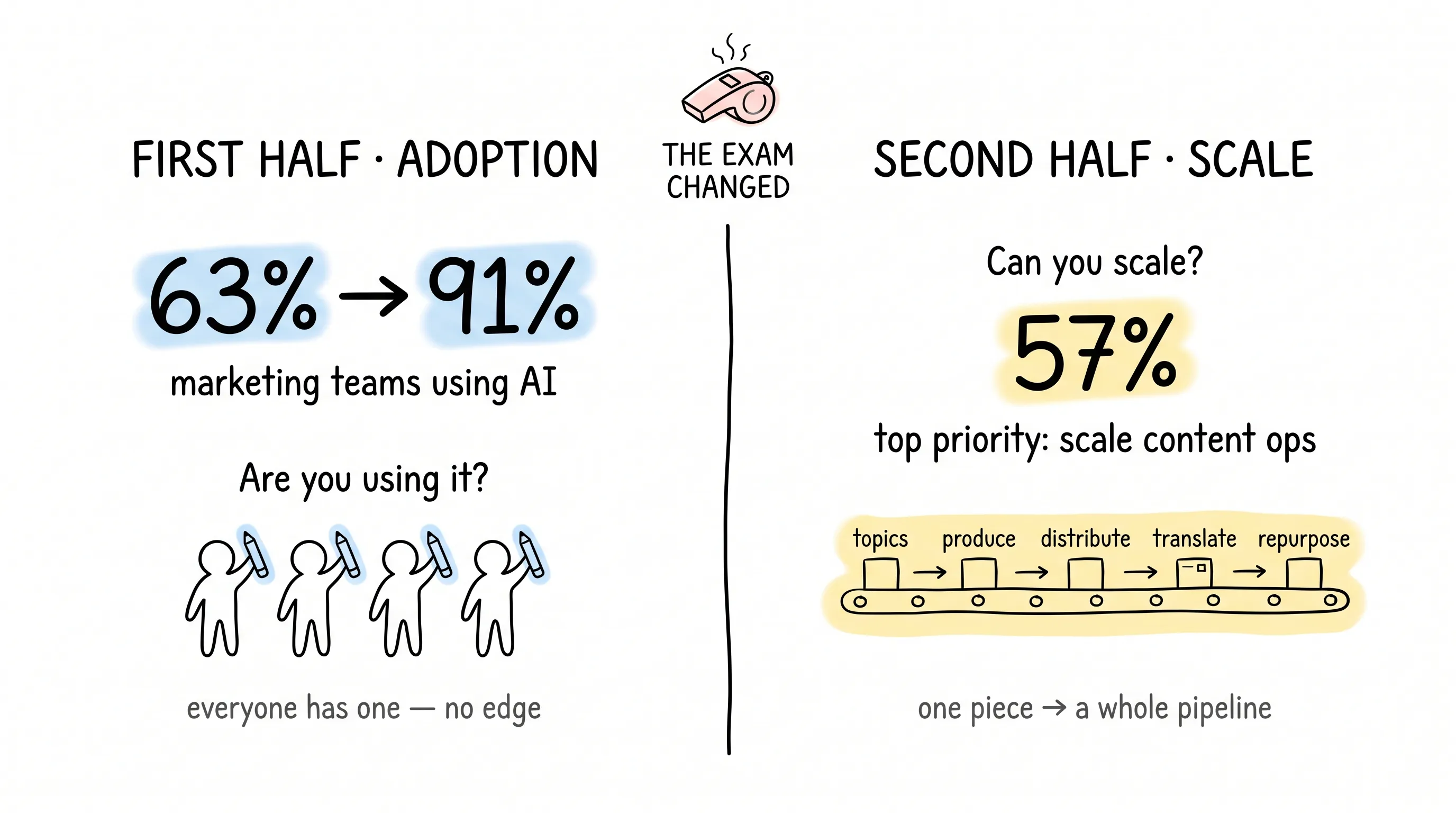
The report says 91% of marketing teams are already using AI. A year ago, that number was 63%. In one year, nearly everyone has shown up.
Good grief. The pace of adoption.
And here's the kicker: 97% of marketers say whether a company gives them AI affects whether they'd choose it as an employer. AI has gone from a nice-to-have to water and electricity.
Leadership is putting real money behind it too: 83% of respondents say their management is genuinely invested in AI, and 95% of teams plan to keep adding more.
So you see — when everyone has a gun, the gun itself is no longer an advantage.
When everyone is using it, no one has won.
The Second Half: It's About Scale
So what does the second half compete on?
One word: scale.
What does scaling mean? It means no longer settling for one-shot uses of AI — writing an article, generating an image — and instead making it carry a complete content pipeline. Topic selection, production, multi-channel distribution, translation, repurposing. End to end.
The data says the same. For 57% of marketers, the priority for the next 12 months is scaling content production and operations. Today's most common use is still ideation (56%), but 51% are already using AI to produce a full set of cross-channel content assets in one go. Further down the list: turning personalization (50%), optimization for traditional and AI search (43%), and localization (33%) into reusable processes.
From "writing one piece" to "building one production line."
That is the watershed.
But the Choke Point Has Changed Hands
The interesting part of this story is that the bottleneck has moved too.
In 2025, what frustrated marketers most about AI? Not enough budget, and no one on the team who understood it. All questions of whether you could even get a seat at the table.
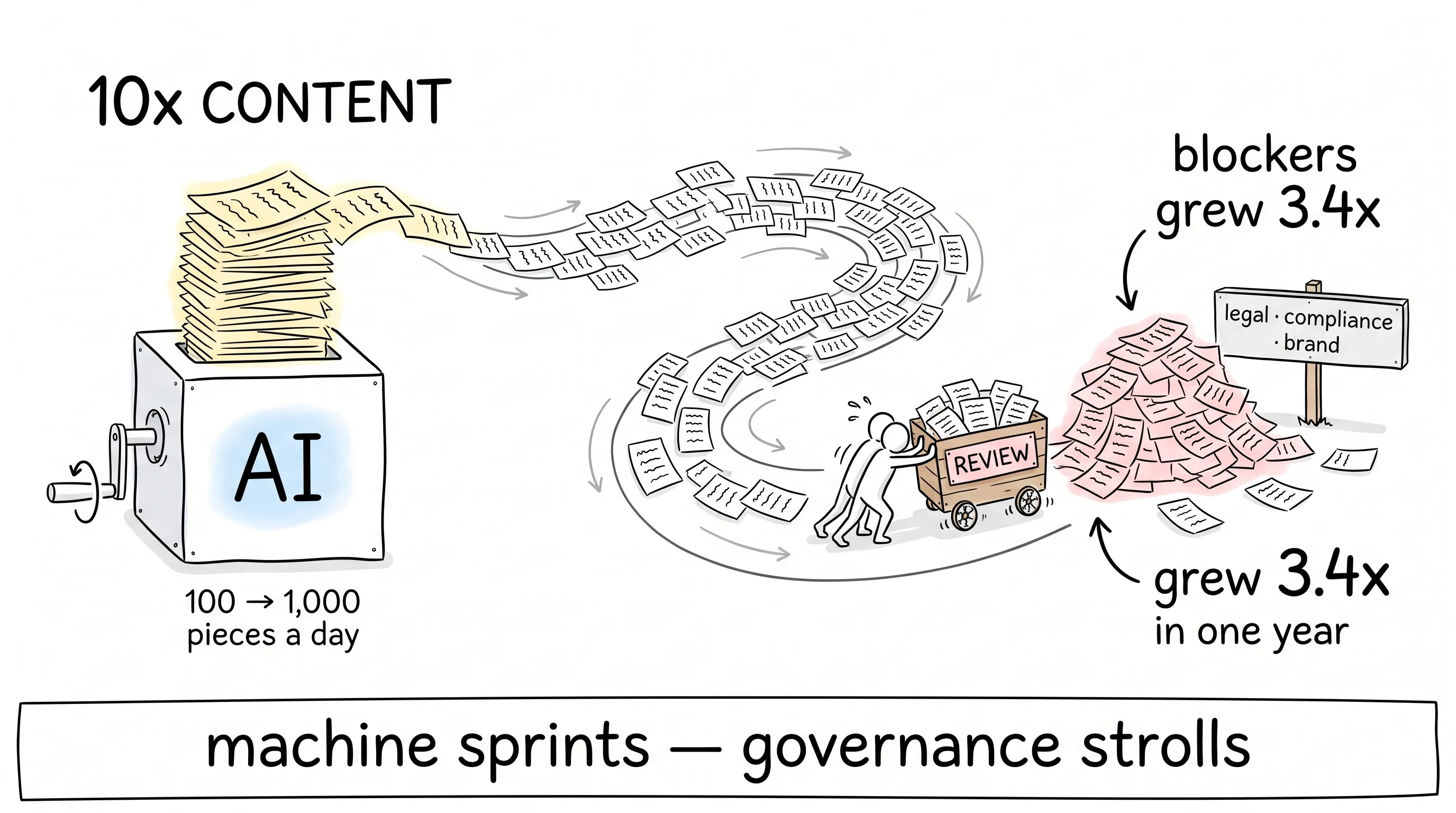
And now? Those headaches have clearly faded, and a new roadblock has surfaced: legal, compliance, brand review.
This kind of block has grown 3.4x in a year.
Why? Picture a scenario: when you produced 10 pieces of content a day, review was a small lift. Now it's 100 pieces, 1,000 pieces a day. AI generates at full speed, but the people reviewing it are still the same small line. The machine is running a 100-meter sprint, and the goalkeeper is still out for a walk.
Content capacity grew tenfold, but the governance process is still a rickshaw.
So marketing teams can no longer work with the door shut. They have to pull in legal, compliance, and brand to set the rules and build the guardrails together. It's a hassle. But there's no dodging it.
A Paradox: ROI Is Getting Harder to Prove
Here's another counterintuitive number, one I stared at for a long time.
The share of marketers who can confidently prove the return on their AI investment fell from 49% a year ago to 41%.
Strange, right? People are using AI more and investing more, yet they're less able to say whether it's worth it.
Here's my read: AI is still AI. What changed is the exam. Before, showing how many hours you saved was enough. Now that AI is inside core processes, the boss wants it accountable for leads, for performance, for revenue. The ledger has gotten much bigger.
That said, those willing to run the numbers seriously get paid well for it. Among teams that actually track AI returns, 60% have gotten at least a two-fold return.
The math isn't the problem. Never running the math is.
The Money Keeps Pouring In
Don't let the friction above scare you off. The money? Still coming in.
95% of marketers plan to increase AI investment in 2026; 66% are ready to carve more than 10% of their marketing budget out for AI.
And notice what the money is buying: infrastructure, long-term capability. AI is being built the way companies once built their websites and CRM systems — as a long-term investment, not a one-time experiment.
A Crack: CMOs and the Front Line Are Not Thinking the Same Thing
The most gut-punching set of numbers in the whole report is this one.
61% of CMOs are confident in AI's return on investment. Frontline employees? 12%.
85% of CMOs feel AI has improved job satisfaction. The frontline experience? 56%.
Nearly a fivefold gap.
Why? Stand on the front line for a moment and you'll get it. Upstairs says AI must boost efficiency, must scale. The targets get pushed down, and the work is still yours to do. How do you do it? No one gives you a process. No one gives you training. Even your role definition is vague. Leaders see a strategic blueprint; employees carry concrete pressure.
How do you close the crack? The answer isn't sexy: make clear who owns what, provide structured training, and reset expectations to match reality.
But anyone who has actually managed people knows: the unsexy work is the real work.
Jobs Are Being Remolded
AI is remolding the job of "marketer" itself.
Three numbers to chew on: for one in three marketers, the job already includes building AI systems or content pipelines; another third is responsible for setting AI strategy, governance, and policy; and 65% of marketing organizations have already created roles dedicated to managing AI workflows.
Over the next 12 months, the new roles on hiring lists: AI search specialist (40%), in charge of whether the brand shows up in AI search; AI transformation lead (34%), in charge of pushing adoption across departments; AI architecture and operations (31%), in charge of system reliability, integration, and scaling.
But there's one gap I think is especially worth flagging: even though "scaling" is the number-one goal, only 19% of teams plan to hire "content engineers" — the people who build content as a system.
The people needed most are the ones being hired least.
In the End: Maturity Is What Sets the Winners Apart
So what ultimately decides who pulls ahead?
The report's answer is clear: maturity.
High-maturity teams share a few traits: they build content as a system, invest with a long-term operating mindset, and use domain-specific tools instead of chasing whatever is hot.
The results? 61% of high-maturity teams can show returns, versus 41% overall; 66% say AI has improved job satisfaction, versus just 15% for novice organizations; 86% of their executives are genuinely invested, versus 32% for novice organizations.
While others are still asking whether to use AI, they are already building their moats.
A Few Last Words
I closed the report. The tea had gone cold, but I was more excited than when I started.
The 1,400 responses all point to the same thing: the experimentation period is over. AI has gone from being a tool to being part of marketing infrastructure. What separates people next is the boring stuff — governance, process, maturity.
Boring is how you know it has truly begun.
Anyone can join the tool party. But systematic operating capability is built slowly, piece by piece.
May you be the one who gets the system built first.
Continue reading
Related articles

Cross-Border Business: Time to Upgrade Your AI Toolbox
A learn article explaining how AI tools help cross-border e-commerce sellers clear five hurdles: language, regulation, logistics, payments, and fraud. It outlines a five-compartment toolbox, a five-step adoption path, and metrics such as conversion rate and CLV, while cautioning against over-reliance on AI.

AI Is Taking Over the Dirty Work of Social Media Marketing, One Task at a Time
This learn article outlines four social media marketing tasks AI can handle — audience analytics, content drafting and design, ad targeting and creative testing, and spam moderation — and cautions that taste, judgment, and data security remain human responsibilities.

AI Is Already This Good — Why Is Your Social Media Marketing Still Pure Manpower?
An overview of 18 AI tools for social media marketing, organized into six categories covering audience research, content creation, scheduling, comment and DM handling, ad management, and visual production, plus notes on personalization, prediction, and emerging trends.